Overdue BAS for musicians: gig fees, APRA royalties and the band
For a musician catching up on BAS, the income comes in three streams: gig fees (taxable once you are registered), royalties (APRA AMCOS only pays GST on them once you return its recipient-created tax invoice agreement) and band money (a band run as a partnership has its own ABN and GST registration, separate from yours). Gear is a GST credit in 1B, like strings and travel.
Import and categorise free. Preparing the BAS is on ELITE+ and AUTO+. 2Fin prepares the figures; you or your BAS agent lodge them with the ATO.
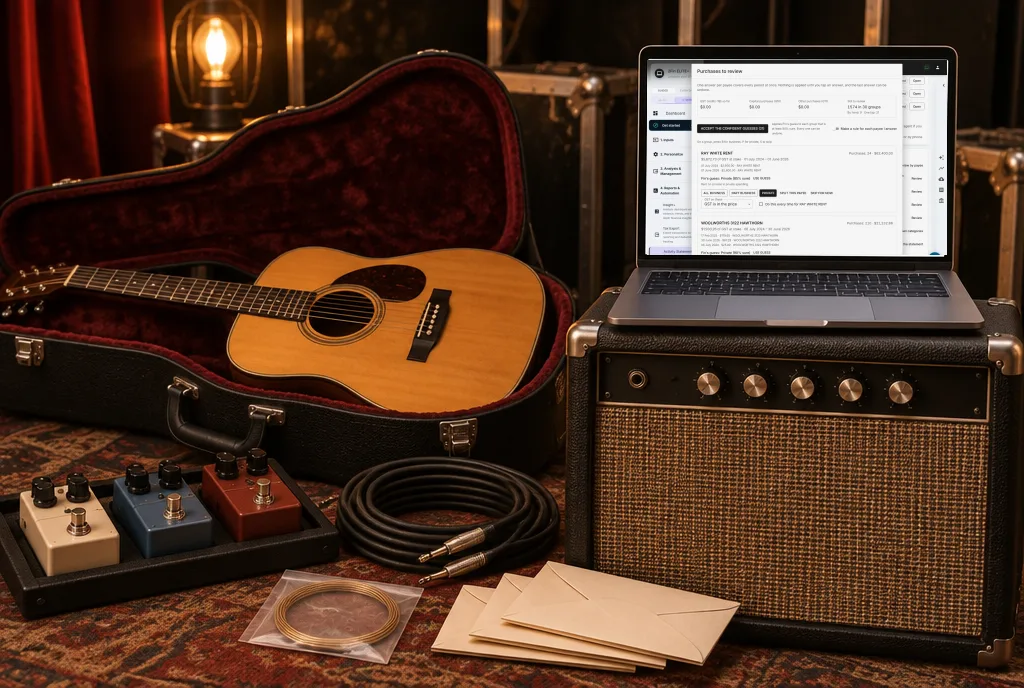
A musician’s income and GST, by stream
From the ATO and APRA AMCOS’s own pages, read on 12 November 2026.
| Stream | What applies | Source |
|---|---|---|
| Gig fees | Taxable sales once you are registered: GST in 1A | ATO, registering for GST |
| APRA AMCOS royalties | GST paid only once you return the RCTI agreement; without an ABN, 47% withheld above $500 (APRA) or $75 (AMCOS) | APRA AMCOS |
| Band as a partnership | Its own TFN, ABN and GST registration at $75,000; members cannot register for the band’s enterprise | ATO, business structures |
| Your own session work | Your own enterprise: your own registration | ATO, GSTR 2004/6 |
| Gear, strings, travel | GST credit in 1B, business share, tax invoice over $82.50 | ATO, claiming GST credits |
| Performing arts loss | Usable in the year if other income is under $40,000 | ATO, excepted business activities |
Let 2Fin do the boring bits
Catching up is mostly sorting, and sorting is the part 2Fin takes off you. Bring in two years of bank statements at once — CSV, Excel or PDF, several files in one go — and Fin reads every line; in testing, 1,891 transactions came in in about a second on a desktop computer. Each transaction is categorised with its GST or VAT worked out, every overdue quarter is listed with its due date, and Fill all periods saves a draft of each one with a single press.
What is left for you is the decisions, not the data entry. Purchases are grouped by payee — the music shop, the rehearsal room, the software — so you answer each payee once and the answer covers every quarter. Fin’s confident guesses (80% sure or more) can be accepted in one tap and undone one by one, and a payee can become a rule so the next import sorts itself. Every figure opens to the transactions inside it, and the finished statements export for you or your agent to check and lodge.
Gig fees
Once you are registered, a gig fee is a taxable sale: one-eleventh of what you are paid is GST to report in 1A, and a venue or promoter can ask you for a tax invoice for anything over $82.50. Every fee counts toward the $75,000 threshold, cash on the night included. In a catch-up, match each gig to the payment that arrived, which is often weeks later.
APRA AMCOS royalties
APRA AMCOS treats your royalties as payment for rights you grant it, and issues a recipient-created tax invoice (RCTI) for them. It will only add GST to your royalties once you have returned the RCTI agreement, on paper or in the Writer Portal under your business details. If you registered for GST during the years you are catching up, check when the agreement was returned: royalties before then were paid without GST. Tell APRA AMCOS if you ever cancel your registration.
Without an ABN, APRA AMCOS withholds 47% from royalty payments over $500 (APRA) or $75 (AMCOS); you claim it back in your tax return. Writer members need an individual (sole trader) ABN.
The band, and your own work
A band run as a partnership has its own tax file number and ABN, registers for GST at $75,000 of its own turnover, and lodges its own BAS. Its members cannot register for the band’s enterprise themselves, but can register for one they run separately, such as solo or session work. Each member reports their share of the band’s net income, equally unless a written agreement says otherwise. This is general information. Check what applies to you with a registered tax or BAS agent, or with the tax office.
Streaming income, losses and averaging
For income from subscribers through an overseas platform, the ATO’s worked example splits GST-free offshore sales from taxable Australian ones by subscriber location, and treats them all as taxable when the locations cannot be found. On income tax, a loss from performing can be used in the year it happens if your other income is under $40,000, and performers can average their income across years. In the UK, HMRC’s Flat Rate Scheme list has no entry for musicians, so check with HMRC or your agent which sector applies.
Take it further
Add or remove GST/VAT on any amount, with the formula shown every time.
2Fin for artists & musicians →The gig fee, the gear, the agent’s cut
ABN (Australian Business Number) →The 11-digit number that identifies your business.
GST (Goods and Services Tax) →Australia’s flat 10% tax on most goods and services.
Sole trader →The simplest business structure — you and the business are one.
Common questions
Do musicians charge GST on gig fees?
Once registered, yes: gig fees are taxable sales, so one-eleventh of each fee is GST. You must register once your turnover reaches $75,000, counting every gig, cash included. This is general information. Check what applies to you with a registered tax or BAS agent, or with the tax office.
Why didn’t APRA AMCOS pay GST on my royalties?
APRA AMCOS only pays GST on royalties after you return its recipient-created tax invoice agreement, which you can do in the Writer Portal under your business details. Royalties paid before that carried no GST.
Does my band need its own ABN?
A band run as a partnership has its own ABN and tax file number, registers for GST once its own turnover reaches $75,000, and lodges its own BAS. Each member reports their share of its net income.
Can I claim GST on a new guitar or amp?
Once registered, yes, at the business-use share, with a tax invoice for anything over $82.50 including GST. On Simpler BAS the credit goes straight into 1B.
Sources
- APRA AMCOS — Forms (RCTI agreement) — GST is paid on royalties once the RCTI agreement is returned
- APRA AMCOS — ABN — 47% withheld without an ABN above $500 (APRA) or $75 (AMCOS)
- ATO — Tax invoices — issue within 28 days on request; RCTI rules; last updated 18 Sep 2026
- ATO — Business structures: key tax obligations — a partnership has its own ABN and GST registration; last updated 9 Jun 2026
- ATO — When you can claim a GST credit — tax invoice needed over $82.50 including GST; business portion only; 4-year limit; last updated 14 Sep 2026
- ATO — Exports and GST — GST-free services to overseas clients; goods exported within 60 days; exports count toward the threshold; last updated 28 Jul 2023
- ATO — Excepted business activities — professional arts business with other income under $40,000; last updated 7 Apr 2025
- ATO — Income averaging for special professionals 2026 — artists, performers and authors; last updated 30 May 2026
- ATO — Registering for GST — $75,000 threshold ($150,000 non-profit); taxi and ride-sourcing register regardless; 21 days; backdating generally limited to 4 years; last updated 14 Sep 2026
- ATO — GSTR 2004/6, partnerships — partners cannot register for the partnership’s enterprise (paragraphs 109–110)
- GOV.UK — VAT Flat Rate Scheme: how much you pay — flat rate by trade; 16.5% for a limited cost business
General information computed from published government guidance, not personal tax advice.
More on catching up on overdue returns
Two years of overdue BAS is eight quarters. Lodge all of them, oldest first, even if you can’t pay: the ATO’s failure-to-lodge penalty is one penalty unit ($364 from 1 July 2026) for each 28 days late, capped at five for a small business, and a nil or refund BAS is generally not penalised. With 2Fin, eight quarters were prepared from a bank file for review in about 10 minutes of modelled person time. You or your BAS agent lodge.
Overdue BAS for artists: grants, gallery sales and GSTFor a visual artist catching up on BAS, the questions are grants and galleries. A grant that obliges you to do something in return — an exhibition, a commissioned work — is generally payment for a supply and carries GST if you are registered. When a gallery sells your work as your agent, the sale is yours to report and the gallery charges GST on its commission, which you claim back.
Overdue BAS for freelancers: overseas clients, platform fees and GSTA freelancer catching up on BAS has to sort clients by where they are. Work for an overseas client who is not in Australia is generally GST-free, but it still counts toward the $75,000 registration threshold and still goes in G1. Platform fees can carry GST until you give the platform your ABN, and some never refund it. Quote your ABN and GST status to overseas suppliers so they stop charging GST.
How to catch up on overdue GST, VAT or BAS returnsTo catch up on overdue GST, VAT or BAS returns: work out every period you owe, rebuild each one from your bank history, file them all — oldest first — even if you can’t pay yet, then set up a payment plan and ask about penalty relief. Late filing usually costs less than not filing, and most tax offices go easier on people who come forward first. 2Fin does the bulk sorting: bring in years of bank statements at once and every overdue period is prepared for you to check; you or your agent file them.
Get your music quarters prepared
Import your bank history free. Fin sorts gigs, royalties and gear into each quarter for you to check.
Get 2Fin free →Back to all guides, or explore the glossary.