Overdue BAS for artists: grants, gallery sales and GST
For a visual artist catching up on BAS, the questions are grants and galleries. A grant that obliges you to do something in return — an exhibition, a commissioned work — is generally payment for a supply and carries GST if you are registered. When a gallery sells your work as your agent, the sale is yours to report and the gallery charges GST on its commission, which you claim back.
Import and categorise free. Preparing the BAS is on ELITE+ and AUTO+. 2Fin prepares the figures; you or your BAS agent lodge them with the ATO.
An artist’s GST, line by line
From the ATO’s rulings and pages, read on 12 November 2026.
| Situation | What applies | Source |
|---|---|---|
| Grant with obligations (deliver work, exhibit, perform) | Generally payment for a supply: GST if you are registered | ATO, GSTR 2012/2 |
| Gallery sells your work as your agent | You report the sale; the gallery charges GST on its commission, which you can claim | ATO, consignment sales |
| Gallery buys outright or on sale-or-return | The gallery sells in its own right | ATO, consignment sales |
| Art prizes | Covered by GSTR 2002/3; depends on your registration and whether what you did has a market value | ATO, GSTR 2002/3 |
| Losses in a professional arts business | Can be used in the year if other income is under $40,000 | ATO, excepted business activities |
Let 2Fin do the boring bits
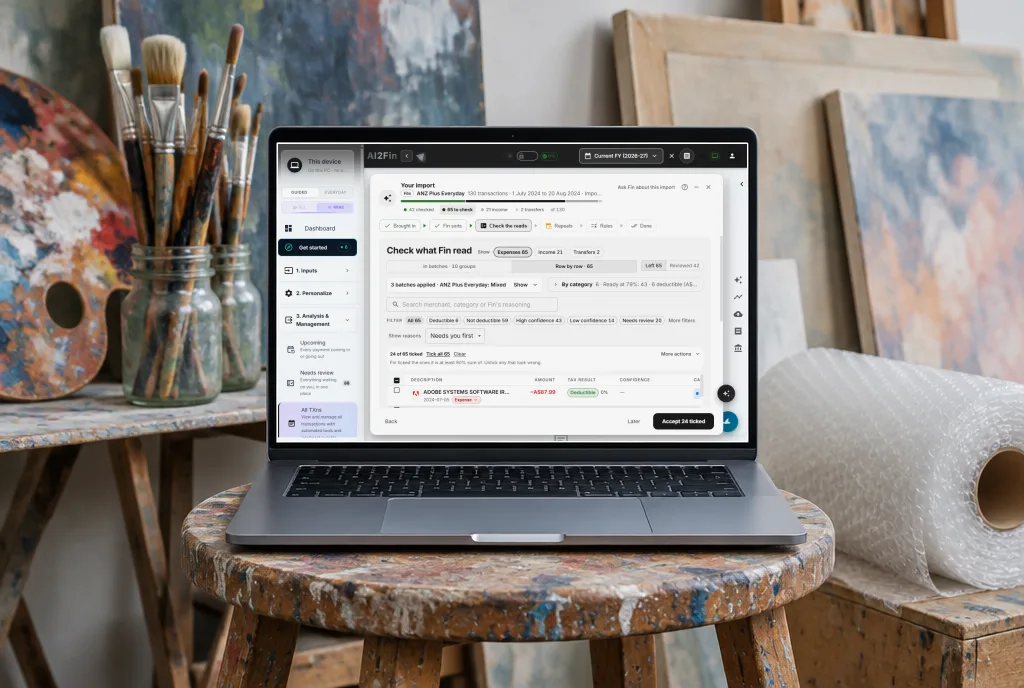
Catching up is mostly sorting, and sorting is the part 2Fin takes off you. Bring in two years of bank statements at once — CSV, Excel or PDF, several files in one go — and Fin reads every line; in testing, 1,891 transactions came in in about a second on a desktop computer. Each transaction is categorised with its GST or VAT worked out, every overdue quarter is listed with its due date, and Fill all periods saves a draft of each one with a single press.
What is left for you is the decisions, not the data entry. Purchases are grouped by payee — the art supplier, the framer, the gallery commission — so you answer each payee once and the answer covers every quarter. Fin’s confident guesses (80% sure or more) can be accepted in one tap and undone one by one, and a payee can become a rule so the next import sorts itself. Every figure opens to the transactions inside it, and the finished statements export for you or your agent to check and lodge.
Grants: when they carry GST
The ATO’s ruling on grants, GSTR 2012/2, asks whether the payment is connected to something you supply. If the grant obliges you to do something in return — stage an exhibition, deliver a body of work, run workshops — it is generally payment for that supply, and if you are registered it carries GST to report in 1A. A grant with no obligation attached may not be. The test is objective, so read the grant agreement, not just the letter. This is general information. Check what applies to you with a registered tax or BAS agent, or with the tax office.
Gallery sales and commission
When a gallery sells your work as your agent — it doesn’t set the price, takes a commission and doesn’t own the work — the sale is yours. If you are registered and selling as part of your business, you report the full sale price and its GST, and the gallery charges you GST on its commission, which you can claim. Only one of you issues the tax invoice to the buyer. If the gallery buys the work, or sells on a sale-or-return basis, it sells in its own right and pays GST on the full price.
In a catch-up, the gallery’s statements show each sale and its commission; your bank only shows the net payout, so match the two.
Prizes, losses and averaging
Prizes are covered by a separate ruling, GSTR 2002/3, which names an artist’s prize for the best painting among its examples; whether a prize carries GST depends on your registration and whether what you did to win has a market value. On the income tax side, a loss from a professional arts business can be used in the year it happens if your other income is under $40,000 (excluding net capital gains); otherwise the general non-commercial loss tests apply, including the $20,000 assessable income test. Artists can also average their income across years.
Artists in the UK or New Zealand
In the UK, HMRC’s Flat Rate Scheme places artists in entertainment or journalism, at 12.5%; VAT registration starts at £90,000. In New Zealand, GST registration starts at $60,000 a year.
Take it further
Add or remove GST/VAT on any amount, with the formula shown every time.
2Fin for artists & musicians →The gig fee, the gear, the agent’s cut
GST (Goods and Services Tax) →Australia’s flat 10% tax on most goods and services.
Tax invoice →The GST-compliant invoice that lets a buyer claim the GST back.
Sole trader →The simplest business structure — you and the business are one.
Common questions
Is an arts grant subject to GST?
When the grant obliges you to do something in return, such as deliver or exhibit work, it is generally payment for a supply and carries GST if you are registered. A grant with no obligation attached may not. GSTR 2012/2 is the ATO’s ruling on it. This is general information. Check what applies to you with a registered tax or BAS agent, or with the tax office.
Who pays GST when a gallery sells my painting?
If the gallery sells as your agent, you report the sale and its GST (when registered), and the gallery charges GST on its commission, which you claim back. If the gallery bought the work or sells on sale-or-return, it accounts for the GST itself.
Can an artist claim a loss against a day job?
A loss from a professional arts business can be used in the year it happens if your other assessable income is under $40,000, excluding net capital gains. Above that, the general non-commercial loss tests decide whether it is used now or deferred.
Sources
- ATO — GSTR 2012/2, financial assistance payments — when a grant is payment for a supply
- ATO — Consignment sales — agency sales: the gallery pays GST on its commission; last updated 17 Jul 2020
- ATO — Using an agent — one tax invoice, from you or the agent; last updated 17 Jul 2020
- ATO — Excepted business activities — professional arts business with other income under $40,000; last updated 7 Apr 2025
- ATO — What is a non-commercial loss — $250,000 income requirement; $20,000 assessable income test; last updated 5 Mar 2026
- ATO — Income averaging for special professionals 2026 — artists, performers and authors; last updated 30 May 2026
- ATO — Registering for GST — $75,000 threshold ($150,000 non-profit); taxi and ride-sourcing register regardless; 21 days; backdating generally limited to 4 years; last updated 14 Sep 2026
- GOV.UK — VAT Flat Rate Scheme: how much you pay — flat rate by trade; 16.5% for a limited cost business
- GOV.UK — Register for VAT — £90,000 over 12 months; register within 30 days; VAT due from the date you should have registered
- Inland Revenue — Registering for GST — $60,000 in 12 months; last updated 13 Feb 2025
- ATO — GSTR 2002/3, prizes — when a prize is consideration for a supply
General information computed from published government guidance, not personal tax advice.
More on catching up on overdue returns
Two years of overdue BAS is eight quarters. Lodge all of them, oldest first, even if you can’t pay: the ATO’s failure-to-lodge penalty is one penalty unit ($364 from 1 July 2026) for each 28 days late, capped at five for a small business, and a nil or refund BAS is generally not penalised. With 2Fin, eight quarters were prepared from a bank file for review in about 10 minutes of modelled person time. You or your BAS agent lodge.
Overdue BAS for musicians: gig fees, APRA royalties and the bandFor a musician catching up on BAS, the income comes in three streams: gig fees (taxable once you are registered), royalties (APRA AMCOS only pays GST on them once you return its recipient-created tax invoice agreement) and band money (a band run as a partnership has its own ABN and GST registration, separate from yours). Gear is a GST credit in 1B, like strings and travel.
Overdue BAS for makers: Etsy, markets and handmade giftsFor a maker selling on Etsy or at markets, the first question is whether it is a business at all — the ATO looks at intent, profit, scale, repetition and how business-like you are. Once registered, the GST on your own handmade goods sold from Australia to Australian buyers is yours to account for: the platform rules cover imported goods and digital products, not your sales. Market-stall cash counts too.
Overdue BAS for freelancers: overseas clients, platform fees and GSTA freelancer catching up on BAS has to sort clients by where they are. Work for an overseas client who is not in Australia is generally GST-free, but it still counts toward the $75,000 registration threshold and still goes in G1. Platform fees can carry GST until you give the platform your ABN, and some never refund it. Quote your ABN and GST status to overseas suppliers so they stop charging GST.
Get your studio quarters prepared
Import your bank history free. Fin sorts grants, gallery payouts and supplies into each quarter for you to check.
Get 2Fin free →Back to all guides, or explore the glossary.