Two years of overdue BAS: how to catch up, and what it costs
Two years of overdue BAS is eight quarters. Lodge all of them, oldest first, even if you can’t pay: the ATO’s failure-to-lodge penalty is one penalty unit ($364 from 1 July 2026) for each 28 days late, capped at five for a small business, and a nil or refund BAS is generally not penalised. With 2Fin, eight quarters were prepared from a bank file for review in about 10 minutes of modelled person time. You or your BAS agent lodge.
Import and categorise free. Preparing the BAS is on ELITE+ and AUTO+. 2Fin prepares the figures; you or your BAS agent lodge them with the ATO.
Late BAS: the figures that matter
From the ATO’s pages, read on 12 November 2026. The penalty unit is set by law and changes; check the ATO page for the date of each late BAS.
| What | Figure | Source |
|---|---|---|
| Failure-to-lodge penalty | One penalty unit for each 28 days (or part) late, up to 5 penalty units for a small business; more for medium and large businesses | ATO, failure to lodge on time penalty |
| Penalty unit | $364 for lateness from 1 July 2026 ($330 from 7 November 2024 to 30 June 2026) | ATO, penalty units |
| Most for one late BAS (small business) | 5 × $364 = $1,820, worked out from the two figures above | ATO, as above |
| Nil or refund BAS | Generally no failure-to-lodge penalty, unless one was already applied | ATO, failure to lodge on time penalty |
| Interest on unpaid GST | General interest charge: 11.51% a year for October–December 2026, compounding daily; not tax-deductible from 1 July 2025 | ATO, GIC rates and GIC |
| Quarterly due dates | 28 October, 28 February, 28 April, 28 July | ATO, BAS due dates |
| GST registration | $75,000 GST turnover ($150,000 non-profit); within 21 days of reaching it | ATO, registering for GST |
| GST credits time limit | 4 years from the original BAS due date | ATO, GST credits |
| Records | Keep most records for 5 years | ATO, record keeping |
Let 2Fin do the boring bits
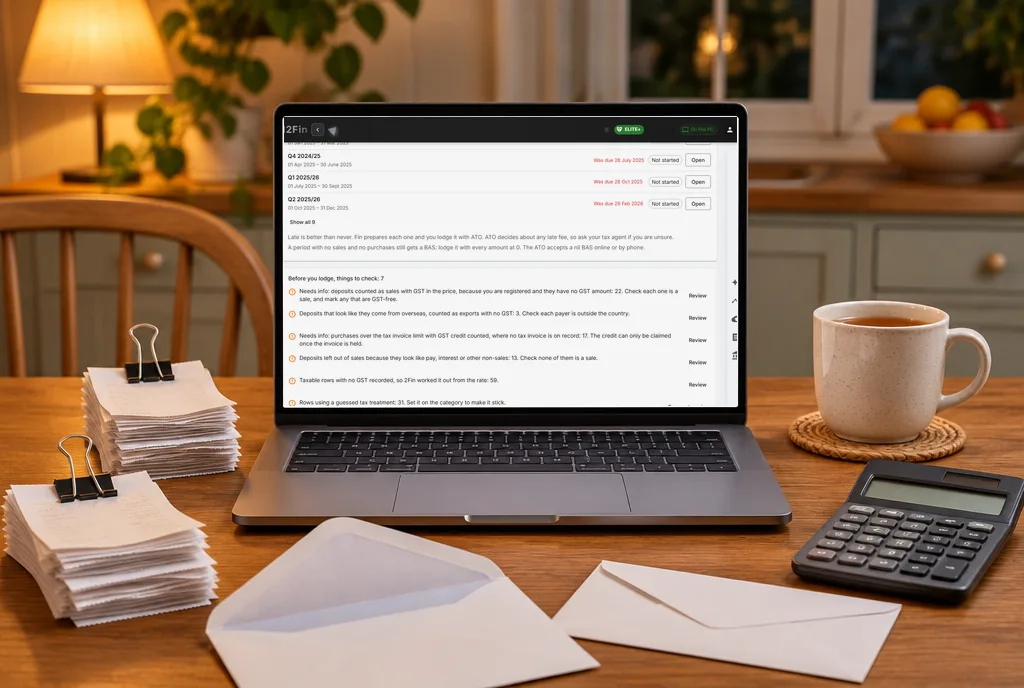
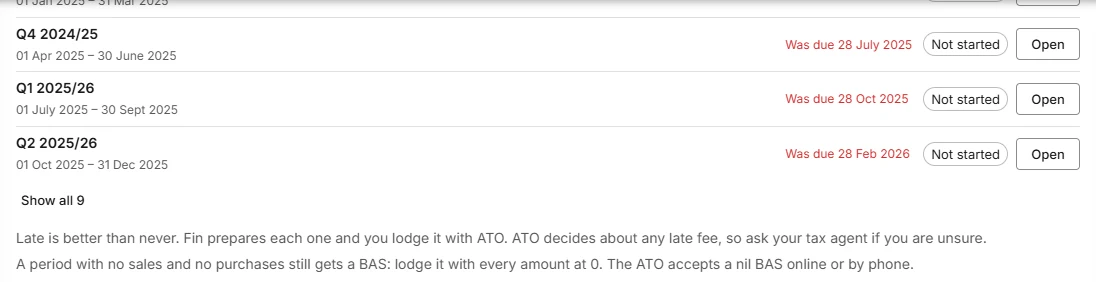
Catching up is mostly sorting, and sorting is the part 2Fin takes off you. Bring in two years of bank statements at once — CSV, Excel or PDF, several files in one go — and Fin reads every line; in testing, 1,891 transactions came in in about a second on a desktop computer. Each transaction is categorised with its GST or VAT worked out, every overdue quarter is listed with its due date, and Fill all periods saves a draft of each one with a single press.
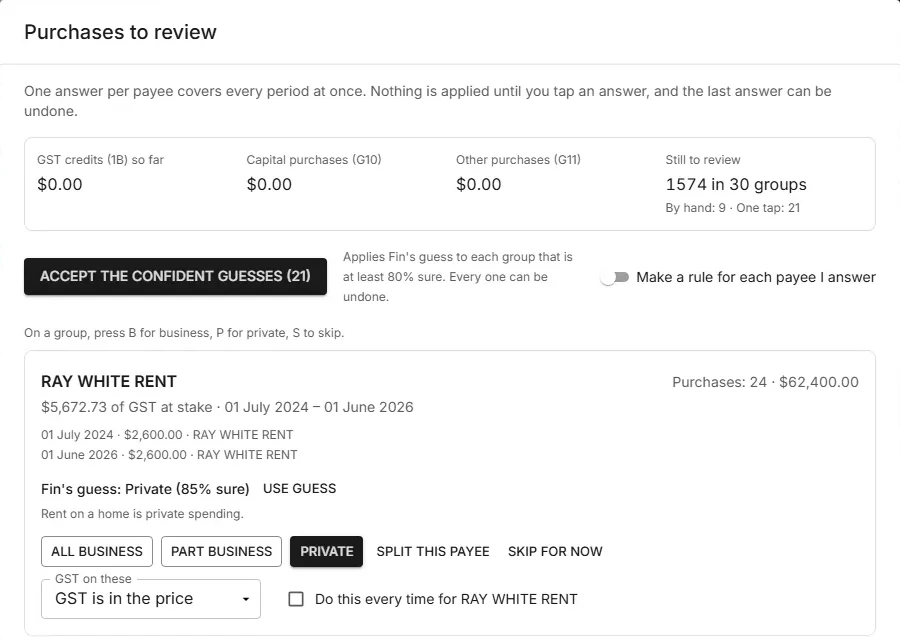
What is left for you is the decisions, not the data entry. Purchases are grouped by payee — in the timed run, 1,574 purchase rows became 30 payees — so you answer each payee once and the answer covers every quarter. Fin’s confident guesses (80% sure or more) can be accepted in one tap and undone one by one, and a payee can become a rule so the next import sorts itself. Every figure opens to the transactions inside it, and the finished statements export for you or your agent to check and lodge.
What happens if you don’t lodge your BAS
The ATO writes first. If statements stay outstanding it can issue a final notice, then a default assessment of the GST it thinks you owe, with a penalty of up to 75% of that amount, and ultimately prosecution. Lodging, even late, replaces all of that with your own figures and a capped late-lodgment penalty.
The ATO also says it generally does not apply the failure-to-lodge penalty to an isolated late lodgment, warns you before it does, and generally does not penalise a late nil or refund BAS. A catch-up lodged before the ATO contacts you is the cheapest version of this problem.
The failure-to-lodge penalty, worked through
The penalty is one penalty unit for every 28 days (or part of 28 days) a BAS is late, up to five penalty units for a small business. A penalty unit is $364 for lateness from 1 July 2026, so a single quarterly BAS that is 5 months late reaches the cap: 5 × $364 = $1,820. Medium businesses ($1 million to $20 million GST turnover) pay double; large businesses five times.
Across eight overdue quarters that could in theory reach eight caps, which is why the remission request matters. The ATO considers remission once your outstanding statements are lodged, and lists severe illness, natural disaster and family violence among the reasons it is likely to accept. This is general information. Check what applies to you with a registered tax or BAS agent, or with the tax office.
The order to lodge in
Lodge the earliest quarter first. The ATO asks that the first activity statement of a financial year be lodged before the later ones, and keeping them in order keeps your GST registration date, credits and any PAYG instalments in sequence. Every overdue BAS can be lodged through Online services for business; an overdue nil BAS can also be lodged by phone, up to three at a time.
A registered BAS agent lodging electronically gets later due dates for current quarters under the ATO’s lodgment program, which is worth knowing if you hand the prepared figures to an agent for the final check.
Rebuilding eight quarters from a bank file
Most catch-ups start with no bookkeeping at all, just bank accounts. Download two years of statements as CSV, Excel or PDF. The sales side of each quarter is the business money in; under Simpler BAS, the default for GST turnover under $10 million, that becomes G1 (total sales) and 1A (GST on sales). The purchases side becomes 1B (GST credits), and that is where your judgement is needed.
In 2Fin the steps are: import the file; enter the date the business registered for GST, and Fin lists every quarter not yet lodged with its due date and status; press Fill all periods to save a draft for each; then answer the purchases review. The review groups every purchase by payee — in the timed run, 1,574 purchase rows became 30 payees — and one answer (all business, part business with a percentage, private, or a capital purchase) applies to every quarter at once. Nothing is applied until you tap, and every answer can be undone.
Purchases: claim what you can prove
You need a tax invoice to claim the GST credit on any purchase over $82.50 including GST, and a supplier has to give you one within 28 days of asking. For purchases at or under $82.50 a receipt or docket is enough. Where something was partly private — a phone, the internet, a car — claim only the business share. In 2Fin, a purchase with no tax invoice yet can be answered No tax invoice: it stays a business cost and its GST credit is held back until you find the invoice.
Claim missed credits while they are in date: they expire 4 years after the original BAS was due, and lodging an amendment does not stretch that. Where you are unsure whether a purchase was for the business, leave it out until you are sure; a missed credit can go in a later BAS within the time limit. This is general information. Check what applies to you with a registered tax or BAS agent, or with the tax office.
If you can’t pay what the BAS shows
Lodge anyway, then set up a payment plan. Smaller debts can be set up through Online services for business or the ATO’s self-help phone line; larger debts, or a plan longer than two years, need a call. The general interest charge keeps accruing on a plan, compounding daily at 11.51% a year for October–December 2026, and since 1 July 2025 it is not tax-deductible, so a shorter plan costs less.
If any quarter was under-reported in a BAS you already lodged, correcting it before the ATO asks is treated as a voluntary disclosure, which the ATO says is likely to reduce penalties and interest.
Never registered, but over $75,000?
You had 21 days to register after your GST turnover reached $75,000. Registering late can mean paying GST on sales from the date you should have registered, even where you didn’t include GST in the price, plus penalties and interest. Backdating is generally limited to 4 years and is arranged by phoning the ATO’s business line. Raise this before lodging any catch-up BAS, because it decides which quarters you owe. This is general information. Check what applies to you with a registered tax or BAS agent, or with the tax office.
How the time was measured
The times on this page come from one recorded run on 10 November 2026, not from a survey of users. The test case was a GST-registered sole trader with a salaried job on the side: two years of bank history, 1,891 transactions, and eight quarterly BAS not yet lodged. The file was imported into the 2Fin app and each quarter prepared from it, on a desktop computer.
The computer’s share — reading the file, categorising every row and filling all eight quarters — took under 3 minutes. The person’s share is modelled rather than stopwatched: 2.5 seconds for each tap and about 6 seconds to decide each payee. On that model the first quarter’s sales figures (G1 and 1A) take about 3 minutes and 18 actions, and all eight quarters, purchases included, take 7.5 to 11.5 minutes. A first-timer reading every screen will be slower; someone who knows their payees, faster.
Purchases are where the checking is. Fin grouped the 1,574 purchase rows into 30 payees, and one answer per payee (all business, part business, private, or a capital purchase) applied to every quarter at once. In that run the eight quarters’ GST credits (1B) came to $1,707.77 against the test’s answer key of $1,500.00, about 14% high; the gap matched the GST on two phone and internet payees answered as 50% business use, which the answer key left out. That is why the figures are prepared for your review, and why every BAS figure in 2Fin opens to show the transactions inside it.
Catching up on BAS, step by step
Confirm your GST registration date
It decides the first quarter you owe. If you should have registered earlier, phone the ATO before lodging.
List the overdue quarters
Match your list to the outstanding statements shown in Online services for business.
Download two years of bank statements
Every account and card the business used, as CSV, Excel or PDF.
Prepare each quarter
Sales give G1 and 1A; purchases you can evidence give 1B. In 2Fin, import the file and fill each quarter from transactions.
Review purchases by payee
Decide what is business, part business, private or a capital purchase, and keep tax invoices for anything over $82.50.
Lodge oldest first
Through Online services for business or your BAS agent; nil BAS can go by phone, three at a time.
Pay or set up a plan, then ask about remission
Set up a payment plan for anything you can’t pay now, and request remission of failure-to-lodge penalties if you have a reason the ATO accepts.
Take it further
Every overdue period listed with its due date, Fill all periods, purchases answered once per payee, and any figure opened to its rows.
Try the bas calculator →Your quarterly GST position — 1A, 1B and the net amount payable, worked out for you.
2Fin for sole traders →One account, two lives, already sorted
BAS (Business Activity Statement) →The form GST-registered businesses use to report GST and PAYG.
GST (Goods and Services Tax) →Australia’s flat 10% tax on most goods and services.
Tax invoice →The GST-compliant invoice that lets a buyer claim the GST back.
GST turnover ($75,000 threshold) →The gross income figure that triggers GST registration.
Common questions
How much is the penalty for a late BAS in 2026?
One penalty unit for each 28 days late, up to five for a small business. A penalty unit is $364 for lateness from 1 July 2026, so the most for one late quarterly BAS is $1,820; a late nil or refund BAS is generally not penalised, and an isolated late lodgment generally isn’t either. This is general information. Check what applies to you with a registered tax or BAS agent, or with the tax office.
Can I do two years of overdue BAS myself?
Yes, if your bank records are complete: each quarter is G1, 1A and 1B under Simpler BAS, and you lodge through Online services for business. The judgement is in the purchases. Many people prepare the figures themselves and have a registered BAS agent check and lodge them.
How long does it take 2Fin to prepare eight overdue quarters?
In a recorded run, two years of one sole trader’s bank history (1,891 transactions) was imported and all eight quarters prepared for review in 7.5 to 11.5 minutes of modelled person time; the computer’s share was under 3 minutes. The first quarter’s sales figures took about 3 minutes. The time is modelled at 2.5 seconds a tap and about 6 seconds a payee decision, not measured on a stopwatch.
Will the ATO charge interest on overdue GST?
Yes. The general interest charge runs from the due date until the GST is paid, compounding daily; it is 11.51% a year for October–December 2026, keeps running on a payment plan, and from 1 July 2025 is no longer tax-deductible.
What if I’m not sure a purchase was for the business?
Leave the credit out until you are sure. A missed GST credit can be claimed in a later BAS within 4 years of the original due date; an overclaimed one becomes a debt with interest. Partly private purchases are claimed at the business share only.
Does 2Fin lodge my BAS with the ATO?
2Fin prepares the figures for you to check. It does not lodge anything with the ATO: you lodge through Online services for business, or your registered BAS or tax agent does. Preparing the BAS is on the ELITE+ and AUTO+ plans; importing and categorising your transactions starts free.
Sources
- ATO — Failure to lodge on time penalty — one penalty unit per 28 days late, up to 5 for small business; nil and refund BAS generally not penalised; remission; last updated 22 Jun 2026
- ATO — Penalty units — $364 from 1 Jul 2026; $330 from 7 Nov 2024; last updated 26 Jun 2026
- ATO — General interest charge rates — 11.51% a year for Oct–Dec 2026, compounding daily; last updated 4 Sep 2026
- ATO — General interest charge — GIC incurred on or after 1 Jul 2025 is not deductible; last updated 10 Jun 2026
- ATO — Due dates for lodging and paying your BAS — quarterly 28 Oct, 28 Feb, 28 Apr, 28 Jul; monthly 21st; last updated 17 Sep 2026
- ATO — How to lodge your BAS — nil BAS by phone for current or overdue statements, up to 3 at a time; last updated 14 Sep 2026
- ATO — Lodgments in Online services for business — lodge overdue statements; lodge the first statement of the financial year before later ones
- ATO — What if you can’t lodge and pay on time — lodge even when you can’t pay; contact the ATO
- ATO — If you don’t lodge — default assessment, penalties, prosecution
- ATO — Setting up a payment plan — self-serve online or by phone for smaller debts; phone for larger debts or plans longer than 2 years; GIC keeps accruing; last updated 6 Nov 2026
- ATO — GST voluntary disclosures — telling the ATO first is likely to reduce penalties and interest
- ATO — Liability and penalties for voluntary corrections — 80% reduction before notice of an examination; last updated 27 Mar 2026
- ATO — Registering for GST — $75,000 threshold ($150,000 non-profit); taxi and ride-sourcing register regardless; 21 days; backdating generally limited to 4 years; last updated 14 Sep 2026
- ATO — When you can claim a GST credit — tax invoice needed over $82.50 including GST; business portion only; 4-year limit; last updated 14 Sep 2026
- ATO — Act early to protect your GST credit entitlements — GST credits expire after 4 years
- ATO — GST reporting methods — Simpler BAS (G1, 1A, 1B) is the default under $10 million GST turnover
- ATO — BAS agent lodgment program 2026–27 — later due dates when a registered agent lodges electronically; last updated 1 Jul 2026
- ATO — Record keeping for business — keep most records for 5 years; last updated 18 Jun 2026
General information computed from published government guidance, not personal tax advice.
More on catching up on overdue returns
To catch up on overdue GST, VAT or BAS returns: work out every period you owe, rebuild each one from your bank history, file them all — oldest first — even if you can’t pay yet, then set up a payment plan and ask about penalty relief. Late filing usually costs less than not filing, and most tax offices go easier on people who come forward first. 2Fin does the bulk sorting: bring in years of bank statements at once and every overdue period is prepared for you to check; you or your agent file them.
Overdue BAS for tradies: the ute, cash jobs and catching upFor a tradie two years behind on BAS, the money is usually in the vehicle and the cash. A ute built to carry a tonne or more is outside the car limit, so its GST credit is the business share of the full GST; a car is capped at $6,353 for 2026–27. Cash jobs are sales and count toward the $75,000 threshold. Lodge every quarter oldest first, then set up a payment plan for what you can’t pay.
Overdue BAS for freelancers: overseas clients, platform fees and GSTA freelancer catching up on BAS has to sort clients by where they are. Work for an overseas client who is not in Australia is generally GST-free, but it still counts toward the $75,000 registration threshold and still goes in G1. Platform fees can carry GST until you give the platform your ABN, and some never refund it. Quote your ABN and GST status to overseas suppliers so they stop charging GST.
How BAS lodgement works, step by stepA Business Activity Statement (BAS) reports the GST you have collected and paid to the ATO, usually every quarter. Here is what actually happens, step by step.
Get your overdue quarters prepared
Import your bank history free. Fin fills each quarter for you to check, and you or your BAS agent lodge.
Get 2Fin free →Back to all guides, or explore the glossary.