How to catch up on overdue GST, VAT or BAS returns
To catch up on overdue GST, VAT or BAS returns: work out every period you owe, rebuild each one from your bank history, file them all — oldest first — even if you can’t pay yet, then set up a payment plan and ask about penalty relief. Late filing usually costs less than not filing, and most tax offices go easier on people who come forward first. 2Fin does the bulk sorting: bring in years of bank statements at once and every overdue period is prepared for you to check; you or your agent file them.
Import and categorise free. Preparing the BAS, VAT or GST statement is on ELITE+ and AUTO+. 2Fin prepares; you or your agent file.
Overdue returns at a glance, by country
What a sole trader or small business faces for one late GST or VAT return, from each tax office’s own pages, read on 12 November 2026. Penalties and interest change; follow the source before relying on a figure.
| Country and return | Must register at | Filing late | Paying late | Source |
|---|---|---|---|---|
| Australia — BAS | $75,000 GST turnover ($150,000 non-profit); rideshare and taxi from the first trip | One penalty unit ($364 from 1 July 2026) for each 28 days late, up to 5 for a small business. Nil and refund BAS are generally not penalised | General interest charge, compounding daily: 11.51% a year for October–December 2026 | ATO |
| United Kingdom — VAT Return | £90,000 taxable turnover in 12 months | One penalty point per late return; at 4 points (quarterly filers) a £200 penalty, and £200 for each further late return | 3% at day 16, another 3% at day 31, then 10% a year, plus interest at base rate + 4% | HMRC |
| Canada — GST/HST return | $30,000 in a quarter or over four quarters; taxi and ride-sharing drivers regardless | 1% of the amount owing plus 0.25% for each full month late, up to 12 months | Interest compounding daily: 7% for October–December 2026 | CRA |
| New Zealand — GST return | $60,000 in 12 months | $50 on the payments basis; $250 on the invoice or hybrid basis | 1% the day after the due date and 4% on day 7, plus use-of-money interest at 8.97% | Inland Revenue |
| Singapore — GST F5 | S$1 million taxable turnover | S$200 a month the return is outstanding, up to S$10,000 a return, and an estimated assessment | 5%, then 2% a month after 60 days, up to 50% of the tax | IRAS |
| India — GSTR-3B | ₹20 lakh aggregate turnover (₹10 lakh in special category States) | A late fee for each day late, per Act; a return cannot be filed more than three years after its due date | Interest on the tax paid in cash, at the notified rate | CBIC, GST portal |
| South Africa — VAT201 | R2.3 million from 1 April 2026 (SARS is applying it ahead of the law) | No penalty for submitting a VAT return late | 10% of the late VAT, plus interest at 10.25% a year | SARS |
| United States — sales tax | Set by each state, not nationally | Set by each state | Set by each state; most offer voluntary disclosure agreements | Multistate Tax Commission |
Let 2Fin do the boring bits
Catching up is mostly sorting, and sorting is the part 2Fin takes off you. Bring in two years of bank statements at once — CSV, Excel or PDF, several files in one go — and Fin reads every line; in testing, 1,891 transactions came in in about a second on a desktop computer. Each transaction is categorised with its GST or VAT worked out, every overdue period is listed with its due date, and Fill all periods saves a draft of each one with a single press.
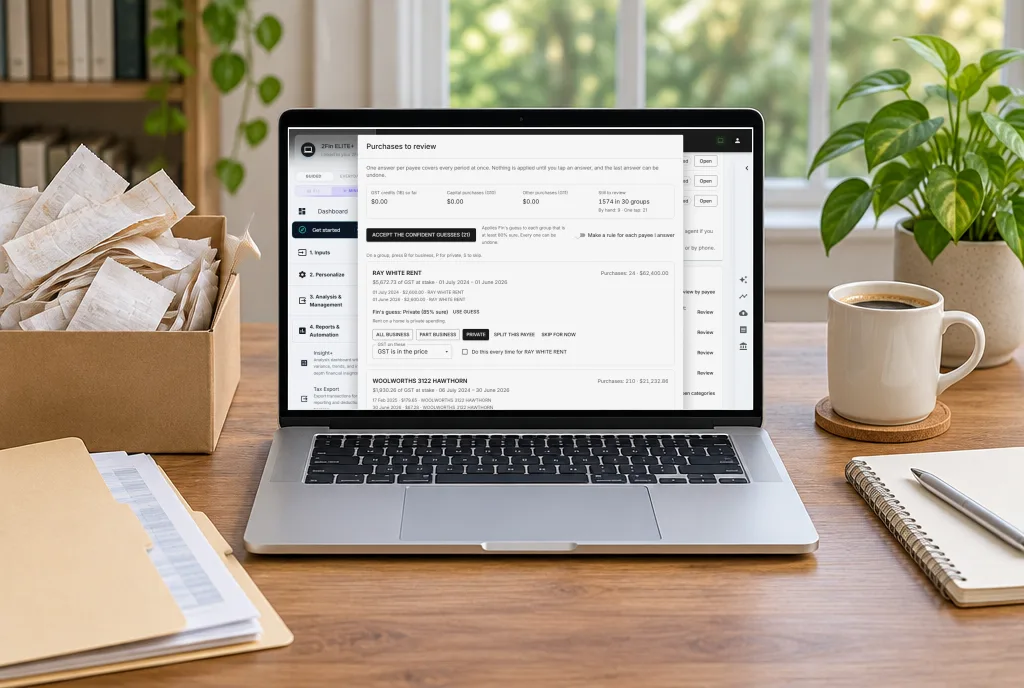
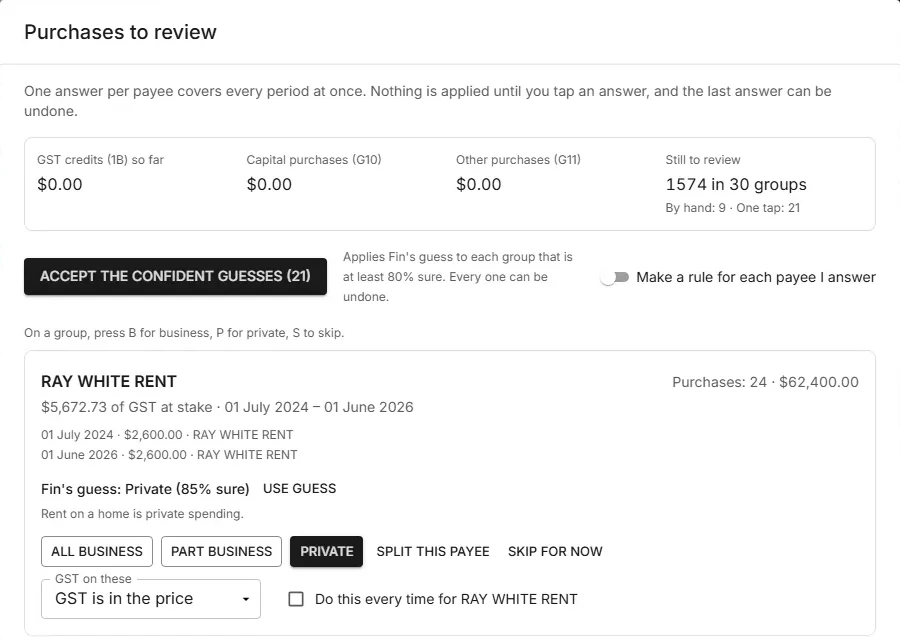
What is left for you is the decisions, not the data entry. Purchases are grouped by payee — the hardware store, the phone company, the software subscription — so you answer each payee once and the answer covers every period. Fin’s confident guesses (80% sure or more) can be accepted in one tap and undone one by one, and a payee can become a rule so the next import sorts itself. Every figure opens to the transactions inside it, and the finished statements export for you or your agent to check and lodge.
First, the reassuring part
Being a year or two behind is common, and every tax office has a route back. The penalties for filing late are usually fixed or capped; the bigger risks come from not filing at all — estimated assessments, larger penalties and, eventually, enforcement. Several offices also reduce penalties for people who come forward before they are contacted: the ATO treats an unprompted correction as a voluntary disclosure, Canada’s Voluntary Disclosures Program has given 75% interest relief and 100% penalty relief to unprompted applicants since 1 October 2025, and Inland Revenue takes 75–100% off a shortfall penalty disclosed before an audit notice.
So the goal is not perfection on day one. It is getting every overdue period filed with honest figures, in the right order, and talking to the tax office about anything you can’t pay.
Step 1: list every period you owe
Start from the date you registered (or should have registered) and your filing frequency. Two years of quarterly BAS or VAT returns is eight periods; New Zealand’s 2-monthly cycle makes it twelve; an annual GST/HST filer in Canada has two. The tax office’s online account shows which periods it expects, and that list is the one to match.
If you went over the registration threshold and never registered, that is a separate problem to raise first: in Australia, the UK, Canada and Singapore you can owe GST or VAT from the date you should have registered, even on sales where you never charged it. Registration can be backdated (generally up to 4 years in Australia), and telling the tax office before it finds out keeps the penalty lower. This is general information. Check what applies to you with a registered tax or BAS agent, or with the tax office.
Step 2: rebuild each period from your bank history
Your bank statements are the most complete record you have. Download two years of them as CSV, Excel or PDF from each account the business used, including any card you paid business costs on. Sales are the money in; purchases are the money out, less anything private.
Rebuilding by hand means sorting every line into a period and a GST or VAT treatment, then adding them up eight times. That sorting is the part software does well.
Step 3: check the purchases, and keep the invoices
Sales figures are usually straightforward. Purchases need judgement: what was business, what was private, what was a mix, and what was a large item such as a vehicle or equipment. Each tax office needs evidence for the credits you claim — in Australia a tax invoice for any purchase over $82.50 including GST — and credits have a time limit (4 years in Australia), so a catch-up is also the moment to claim the ones you missed before they expire.
Where a purchase was partly private, claim only the business part. Where you are unsure, leave the credit out and ask; you can usually claim a missed credit later, within the time limit, whereas an overclaim is a debt with interest.
Step 4: file everything, then deal with the money
File every overdue return, even the ones with nothing to report and even when you can’t pay. The ATO says to lodge so the amount owed is certain; Canada holds refunds until every required return is filed; Singapore and South Africa only consider a payment arrangement once the outstanding returns are in. In Australia, lodge the first statement of the financial year before the later ones.
Then pay what you can and ask for a plan for the rest: a payment plan with the ATO, Time to Pay with HMRC, a payment arrangement with the CRA, an instalment arrangement in myIR, or a deferral on SARS eFiling. Interest usually keeps running on a plan, so a shorter plan costs less. Finally, ask whether any penalty can be reduced or remitted — illness, disaster and similar reasons are considered by most offices.
Where 2Fin fits, country by country
2Fin prepares the statement from your categorised transactions and stops there: it never files or lodges anything. In Australia it prepares the BAS (G1 to G20, 1A and 1B, W1 and W2) for you to lodge through Online services for business or your BAS agent. In the United Kingdom it fills VAT Return boxes 1 to 9; it is not connected to Making Tax Digital, so you submit through MTD-compatible software or your agent. In Canada it prepares the GST34 with provincial HST rates, in New Zealand the GST101A and in Singapore the GST F5.
In India it fills GSTR-3B table 3.1(a) from your sales, and the input tax credit and other tables are yours to complete. In South Africa it fills the VAT201 summary fields. In the United States, sales tax is set by each state and 2Fin does not prepare it: your sales-tax tool or accountant files, working from the categorised income and spending 2Fin keeps. In every other country, GST or VAT is tracked on each transaction from the national rate on record, with a generic statement and accountant exports.
Importing your bank history and having it categorised starts free; preparing the BAS, VAT or GST statement is on the ELITE+ and AUTO+ plans (see plans).
How the time was measured
The times on this page come from one recorded run on 10 November 2026, not from a survey of users. The test case was a GST-registered sole trader with a salaried job on the side: two years of bank history, 1,891 transactions, and eight quarterly BAS not yet lodged. The file was imported into the 2Fin app and each quarter prepared from it, on a desktop computer.
The computer’s share — reading the file, categorising every row and filling all eight quarters — took under 3 minutes. The person’s share is modelled rather than stopwatched: 2.5 seconds for each tap and about 6 seconds to decide each payee. On that model the first quarter’s sales figures (G1 and 1A) take about 3 minutes and 18 actions, and all eight quarters, purchases included, take 7.5 to 11.5 minutes. A first-timer reading every screen will be slower; someone who knows their payees, faster.
Purchases are where the checking is. Fin grouped the 1,574 purchase rows into 30 payees, and one answer per payee (all business, part business, private, or a capital purchase) applied to every quarter at once. In that run the eight quarters’ GST credits (1B) came to $1,707.77 against the test’s answer key of $1,500.00, about 14% high; the gap matched the GST on two phone and internet payees answered as 50% business use, which the answer key left out. That is why the figures are prepared for your review, and why every BAS figure in 2Fin opens to show the transactions inside it.
Catching up, step by step
List the periods
From your registration date and filing frequency, list every period not yet filed, and match it to the list in your tax office account.
Sort out registration first
If you passed the threshold without registering, raise it with the tax office before filing; registration may be backdated.
Gather the bank history
Download statements for every account and card the business used, covering all the overdue periods.
Prepare each period
Work out sales and the GST or VAT on them, then purchases and the credits you can evidence, for each period separately.
Check, then file oldest first
Check the figures (or have your agent check them) and file every return, nil ones included, starting with the earliest.
Pay or arrange to pay
Pay what you can and set up a payment plan for the rest before the next due date.
Ask about penalties
Request remission, a waiver or voluntary-disclosure relief where your tax office offers it.
Take it further
Every overdue period listed with its due date, Fill all periods, purchases answered once per payee, and any figure opened to its rows.
Try the gst calculator →Add or remove GST/VAT on any amount, with the formula shown every time.
2Fin for sole traders →One account, two lives, already sorted
BAS (Business Activity Statement) →The form GST-registered businesses use to report GST and PAYG.
GST (Goods and Services Tax) →Australia’s flat 10% tax on most goods and services.
Tax invoice →The GST-compliant invoice that lets a buyer claim the GST back.
Common questions
Should I file overdue GST or VAT returns if I can’t pay?
Yes. Filing fixes the amount owed and stops the larger penalties and estimated assessments that come with not filing; paying is a separate step, and every tax office covered here has a payment plan or arrangement for it. Some only consider a plan once the outstanding returns are in. This is general information. Check what applies to you with a registered tax or BAS agent, or with the tax office.
Which overdue return should I file first?
The oldest. In Australia the ATO asks for the first activity statement of a financial year before the later ones, and filing in order keeps carried-forward figures (and any credits) in sequence. If one period is complicated, prepare it carefully but keep the others moving.
Do I still have to file a return if I had no sales?
Yes, in Australia, the UK, Canada, Singapore and the other countries here, a registered business files a return for every period, nil ones included. In Australia an overdue nil BAS can be lodged by phone, up to three at a time, and a nil or refund BAS generally does not attract the failure-to-lodge penalty.
Can I get late filing penalties reduced?
Often. The ATO considers remission once your outstanding returns are lodged; HMRC cancels points and penalties for a reasonable excuse; the CRA can waive penalties and interest under taxpayer relief within 10 years; Inland Revenue waives for a reasonable cause; and coming forward before you are contacted usually earns the largest reduction. This is general information. Check what applies to you with a registered tax or BAS agent, or with the tax office.
How far back can I claim GST or VAT credits I missed?
There is a limit. In Australia GST credits expire 4 years after the original BAS was due, and lodging an amendment does not stretch that; in India input tax credit cannot be taken after 30 November following the end of the financial year. A catch-up is the time to claim what is still in date.
Does 2Fin file the returns for me?
2Fin prepares each period’s statement from your categorised transactions for you to check and stops there: you file it through your tax office’s service or your registered agent does. Importing your bank history and having it categorised starts free; preparing the BAS, VAT or GST statement is on the ELITE+ and AUTO+ plans.
Sources
- ATO — Failure to lodge on time penalty — one penalty unit per 28 days late, up to 5 for small business; nil and refund BAS generally not penalised; remission; last updated 22 Jun 2026
- ATO — Penalty units — $364 from 1 Jul 2026; $330 from 7 Nov 2024; last updated 26 Jun 2026
- ATO — General interest charge rates — 11.51% a year for Oct–Dec 2026, compounding daily; last updated 4 Sep 2026
- ATO — What if you can’t lodge and pay on time — lodge even when you can’t pay; contact the ATO
- ATO — Lodgments in Online services for business — lodge overdue statements; lodge the first statement of the financial year before later ones
- ATO — How to lodge your BAS — nil BAS by phone for current or overdue statements, up to 3 at a time; last updated 14 Sep 2026
- ATO — Registering for GST — $75,000 threshold ($150,000 non-profit); taxi and ride-sourcing register regardless; 21 days; backdating generally limited to 4 years; last updated 14 Sep 2026
- ATO — When you can claim a GST credit — tax invoice needed over $82.50 including GST; business portion only; 4-year limit; last updated 14 Sep 2026
- ATO — Act early to protect your GST credit entitlements — GST credits expire after 4 years
- ATO — GST voluntary disclosures — telling the ATO first is likely to reduce penalties and interest
- GOV.UK — Register for VAT — £90,000 over 12 months; register within 30 days; VAT due from the date you should have registered
- GOV.UK — Penalty points and penalties if you submit your VAT Return late — one point per late return; 4 points for quarterly filers; £200 at the threshold
- GOV.UK — How late payment penalties work if you pay VAT late — 3% from day 16, another 3% from day 31, then 10% a year; last updated 10 Jul 2025
- GOV.UK — Late payment interest if you do not pay VAT or penalties on time — Bank of England base rate plus 4%
- GOV.UK — If you cannot pay your tax bill on time: pay in instalments — Time to Pay plans checked for affordability
- CRA — RC4022, General information for GST/HST registrants — $30,000 small supplier; 29 days to register; filing periods; file every period; 6 years of records
- CRA — GST/HST filing penalties — 1% of the amount owing plus 0.25% a month, up to 12 months; last updated 16 Jun 2025
- CRA — Prescribed interest rates, Oct–Dec 2026 — 7% on overdue GST/HST
- CRA — Changes to the Voluntary Disclosures Program — from 1 Oct 2025: 75% interest and 100% penalty relief unprompted
- CRA — GST/HST Memorandum 16.3, cancellation or waiver of penalties and interest — request within 10 calendar years; form RC4288
- CRA — Contact the CRA about your debt — payment arrangements in My Business Account for $1,000 or more; last updated 27 Oct 2026
- Inland Revenue — Registering for GST — $60,000 in 12 months; last updated 13 Feb 2025
- Inland Revenue — Late filing penalties — $50 payments basis, $250 invoice or hybrid basis; last updated 17 Nov 2025
- Inland Revenue — Late payment penalties — 1% the day after, 4% on day 7; last updated 5 Sep 2024
- Inland Revenue — Interest on overpayments and underpayments — 8.97% from 16 Jan 2026; last updated 8 Jul 2026
- Inland Revenue — Lowering your shortfall penalty — voluntary disclosure before an audit notice: 75–100% off
- Inland Revenue — Waiving payment penalties — reasonable cause or a one-off mistake; last updated 20 Jun 2024
- Inland Revenue — Apply for an instalment arrangement in myIR — weekly, fortnightly or monthly; last updated 16 Oct 2025
- IRAS — Do I need to register for GST — S$1 million; last updated 5 Nov 2026
- IRAS — Late filing or non-filing of GST returns (F5/F8) — S$200 a month, up to S$10,000 a return; last updated 10 Aug 2026
- IRAS — Late payment or non-payment of GST — 5%, then 2% a month up to 50%
- IRAS — Experiencing difficulties in paying your tax — GST generally cannot be paid in instalments; one-time plan; last updated 30 Oct 2026
- CBIC — CGST Act section 22 — ₹20 lakh (₹10 lakh in special category States)
- CBIC — CGST Act section 39(11) — no return after three years from its due date
- GST portal — Create and submit GSTR-3B — late fee charged per day per Act
- SARS — Register for VAT — R2.3 million from 1 Apr 2026; last updated 8 Oct 2026
- SARS — Budget 2026 frequently asked questions — new threshold applied before the law is promulgated; interest 10.25%
- SARS — FAQs for VAT vendors — no penalty for a late VAT return; 10% for paying late
- SARS — Deferral of payment arrangements on eFiling — 1–36 months; not with outstanding returns
- Multistate Tax Commission — Multistate Voluntary Disclosure Program — one process for several states; penalties waived, lookback periods filed
General information computed from published government guidance, not personal tax advice.
More on catching up on overdue returns
Two years of overdue BAS is eight quarters. Lodge all of them, oldest first, even if you can’t pay: the ATO’s failure-to-lodge penalty is one penalty unit ($364 from 1 July 2026) for each 28 days late, capped at five for a small business, and a nil or refund BAS is generally not penalised. With 2Fin, eight quarters were prepared from a bank file for review in about 10 minutes of modelled person time. You or your BAS agent lodge.
Missed VAT returns in the UK: penalty points, late payment and catching upEach VAT return you submit late earns one penalty point. A quarterly filer who reaches 4 points pays £200, and £200 for every late return after that. Late payment is separate: 3% of what is still unpaid at day 16, another 3% at day 31, then 10% a year, plus interest at the Bank of England base rate plus 4%. To catch up, submit every missing return — points only reset once all returns for the previous 24 months are in — then agree Time to Pay for what you can’t pay.
Late GST/HST returns in Canada: penalties, relief and catching upThe CRA’s penalty for a late GST/HST return is 1% of the amount owing plus 0.25% of it for each full month late, up to 12 months; there is none when nothing is owing. Interest compounds daily (7% for October–December 2026). Since 1 October 2025 the Voluntary Disclosures Program gives 75% interest relief and 100% penalty relief to people who come forward before the CRA contacts them. File every period: refunds are held until all returns are in.
Overdue GST returns in New Zealand: penalties and catching upInland Revenue charges $50 for a late GST return on the payments basis and $250 on the invoice or hybrid basis. Paying late adds 1% the day after the due date and 4% on day 7, plus use-of-money interest at 8.97%. File every overdue return as soon as you can — otherwise Inland Revenue issues a default assessment — and set up an instalment arrangement in myIR for what you can’t pay.
Get every overdue period prepared
Import your bank history free, and Fin sorts it into each period for you to check and file.
Get 2Fin free →Back to all guides, or explore the glossary.