Overdue BAS for tradies: the ute, cash jobs and catching up
For a tradie two years behind on BAS, the money is usually in the vehicle and the cash. A ute built to carry a tonne or more is outside the car limit, so its GST credit is the business share of the full GST; a car is capped at $6,353 for 2026–27. Cash jobs are sales and count toward the $75,000 threshold. Lodge every quarter oldest first, then set up a payment plan for what you can’t pay.
Import and categorise free. Preparing the BAS is on ELITE+ and AUTO+. 2Fin prepares the figures; you or your BAS agent lodge them with the ATO.
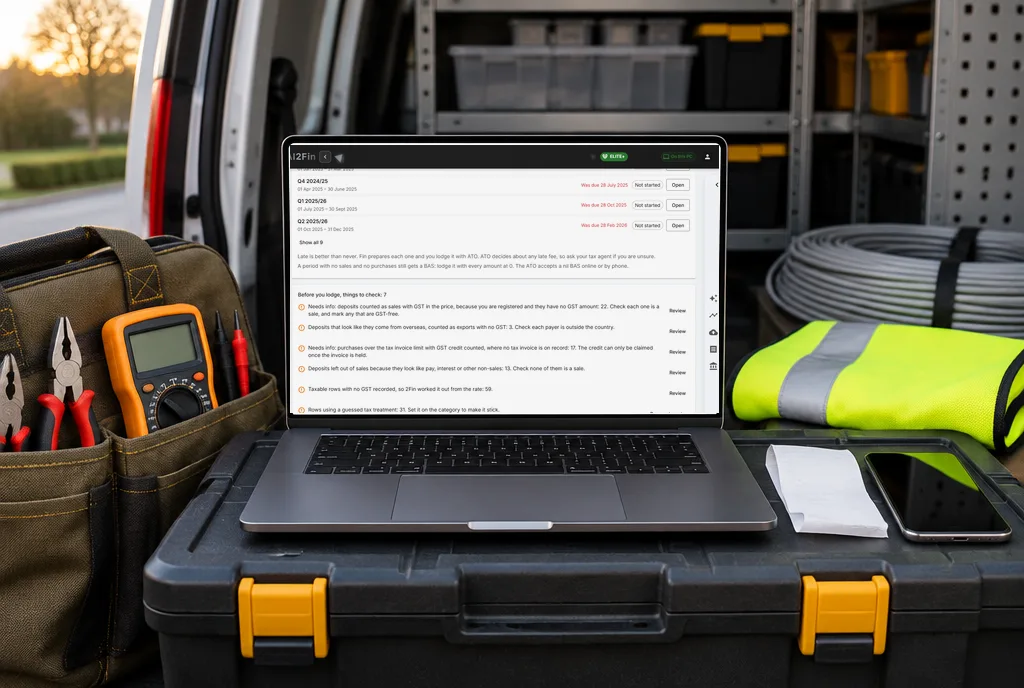
The tradie BAS checklist
The items that move a tradie’s BAS most, from the ATO’s pages read on 12 November 2026.
| Item | GST treatment | Source |
|---|---|---|
| Ute or van, 1 tonne or more | Outside the car limit; business-use share of the GST | ATO, GST and motor vehicles |
| Car or SUV | Credit capped at $6,353 for 2026–27, then the business-use share | ATO, purchasing a motor vehicle |
| Leased vehicle | Credit on the lease payments by business use, not capped at the car limit | ATO, purchasing a motor vehicle |
| Fuel, phone, internet | Business-use share only | ATO, claiming GST credits |
| Cash jobs | Sales: in G1 and 1A for the quarter they were paid | ATO, cash economy |
| Paying subbies (building and construction) | TPAR by 28 August | ATO, TPAR |
Let 2Fin do the boring bits
Catching up is mostly sorting, and sorting is the part 2Fin takes off you. Bring in two years of bank statements at once — CSV, Excel or PDF, several files in one go — and Fin reads every line; in testing, 1,891 transactions came in in about a second on a desktop computer. Each transaction is categorised with its GST or VAT worked out, every overdue quarter is listed with its due date, and Fill all periods saves a draft of each one with a single press.
What is left for you is the decisions, not the data entry. Purchases are grouped by payee — the wholesaler, the fuel card, the phone company — so you answer each payee once and the answer covers every quarter. Fin’s confident guesses (80% sure or more) can be accepted in one tap and undone one by one, and a payee can become a rule so the next import sorts itself. Every figure opens to the transactions inside it, and the finished statements export for you or your agent to check and lodge.
The vehicle: ute, van or car
Whether your work vehicle is a “car” for GST decides how much credit you get. A car carries under a tonne and fewer than nine passengers; a ute or van built for a tonne or more is not one. For a car, the credit is capped at 1/11 of the car limit — $69,883 for 2026–27, so $6,353 — and then reduced to the business-use share. For a heavier ute or van, there is no cap: you claim the business-use share of the GST on the price. A leased car’s lease payments are claimed by business use and are not capped at the car limit either.
Luxury car tax is never claimable, and fuel used in light vehicles on public roads is outside the fuel tax credits scheme; the GST on that fuel is still a normal credit at the business share. This is general information. Check what applies to you with a registered tax or BAS agent, or with the tax office.
Cash jobs
A cash job is a sale. It belongs in the quarter you were paid, in G1, with its GST in 1A, and it counts toward the $75,000 threshold. The ATO treats under-reported cash as a small-business focus area and can raise GST, income tax and penalties up to 75% of the shortfall. A job diary with dates, customers and amounts is a sound record for a catch-up.
Phones, tools and the everyday
Phone, internet, tools and consumables are claimed at the business share with a tax invoice for anything over $82.50. Most tradies are on Simpler BAS, so these credits go into 1B with no capital purchases label to fill. If you are not sure a purchase was for work, leave the credit out for now: a missed credit can be claimed in a later BAS within four years.
Lodging the catch-up
Lodge the oldest quarter first through Online services for business, or hand the prepared figures to a BAS agent to check and lodge. The failure-to-lodge penalty for a small business is one penalty unit ($364 from 1 July 2026) per 28 days late, capped at five, and the ATO considers remission once the outstanding statements are in. The full BAS catch-up guide has the penalties, interest and payment plans.
Take it further
Your quarterly GST position — 1A, 1B and the net amount payable, worked out for you.
2Fin for tradies →The glovebox receipts, already sorted
Tax invoice →The GST-compliant invoice that lets a buyer claim the GST back.
Apportionment →Dividing a shared cost so only the income-earning share is claimed.
TPAR (Taxable Payments Annual Report) →The annual report of what you paid contractors in certain industries.
Common questions
Is a dual-cab ute a car for GST?
It depends on what it was designed to carry. A vehicle designed to carry a load of one tonne or more is not a “car” for GST, so the car limit does not apply; one designed for less than a tonne (and fewer than nine passengers) is a car, and its credit is capped. The manufacturer’s payload figure is the place to look. This is general information. Check what applies to you with a registered tax or BAS agent, or with the tax office.
What is the car limit for GST in 2026–27?
$69,883, so the most GST credit you can claim on a car is $6,353, reduced further to the business-use share. It was $69,674 for 2024–25 and 2025–26.
Do cash jobs go on my BAS?
Yes. Cash is a sale like a bank transfer: include it in G1 for the quarter you were paid, with its GST in 1A once you are registered, and count it toward the $75,000 threshold.
Can I claim GST on fuel?
Yes, the business-use share, with a tax invoice for any fill over $82.50 including GST. Fuel tax credits are a separate scheme and do not cover light vehicles on public roads.
Sources
- ATO — About GST and motor vehicles — a “car” carries under one tonne and fewer than 9 passengers; last updated 29 May 2024
- ATO — Purchasing a motor vehicle (GST) — car limit $69,883 for 2026–27, maximum GST credit $6,353; commercial vehicles outside the limit; last updated 3 Jun 2026
- ATO — When you can claim a GST credit — tax invoice needed over $82.50 including GST; business portion only; 4-year limit; last updated 14 Sep 2026
- ATO — Businesses using cash to dodge obligations — report all income including cash; last updated 1 Oct 2026
- ATO — Taxable payments annual report — due 28 August
- ATO — GST reporting methods — Simpler BAS (G1, 1A, 1B) is the default under $10 million GST turnover
- ATO — Failure to lodge on time penalty — one penalty unit per 28 days late, up to 5 for small business; nil and refund BAS generally not penalised; remission; last updated 22 Jun 2026
- ATO — Penalty units — $364 from 1 Jul 2026; $330 from 7 Nov 2024; last updated 26 Jun 2026
- ATO — Ride-sourcing: registrations — register for GST before your first trip, whatever your turnover; monthly or quarterly only; last updated 20 Aug 2025
General information computed from published government guidance, not personal tax advice.
More on catching up on overdue returns
Two years of overdue BAS is eight quarters. Lodge all of them, oldest first, even if you can’t pay: the ATO’s failure-to-lodge penalty is one penalty unit ($364 from 1 July 2026) for each 28 days late, capped at five for a small business, and a nil or refund BAS is generally not penalised. With 2Fin, eight quarters were prepared from a bank file for review in about 10 minutes of modelled person time. You or your BAS agent lodge.
Overdue BAS for painters: paint receipts, the ute and TPARA painter catching up on BAS needs three things straight: GST credits on paint and gear (with a tax invoice for anything over $82.50), the ute (one built to carry a tonne or more is not a “car”, so the car limit does not cap its GST credit), and the TPAR if you pay other painters — painting is a building and construction service, due 28 August. Cash jobs count as sales like any other.
Overdue BAS for carpenters and joiners: tools, timber and subcontractingCarpenters catching up on BAS usually have two sides to match. Builders who pay you report those payments to the ATO in their TPAR, so your sales should line up with what they reported. Against that, the GST on timber, hardware and tools is yours to claim — with a tax invoice for anything over $82.50 — and if you pay other chippies or joiners, you lodge a TPAR of your own by 28 August.
Job software, accounting software or expense tracking: what tradies actually needJob management quotes and schedules the work, accounting software keeps the ledger and files the returns, and expense tracking sorts what you spent. They are three different jobs, and how many you need moves with crew size and GST registration — except the expense side, which is worth having from the first week because it is what your deductions are built on.
Get your overdue quarters prepared
Import your bank history free. Fin sorts the ute, the cash jobs and the gear into each quarter for you to check.
Get 2Fin free →Back to all guides, or explore the glossary.