Overdue BAS for carpenters and joiners: tools, timber and subcontracting
Carpenters catching up on BAS usually have two sides to match. Builders who pay you report those payments to the ATO in their TPAR, so your sales should line up with what they reported. Against that, the GST on timber, hardware and tools is yours to claim — with a tax invoice for anything over $82.50 — and if you pay other chippies or joiners, you lodge a TPAR of your own by 28 August.
Import and categorise free. Preparing the BAS is on ELITE+ and AUTO+. 2Fin prepares the figures; you or your BAS agent lodge them with the ATO.
A carpenter’s GST, line by line
From the ATO’s pages, read on 12 November 2026.
| Situation | What applies | Source |
|---|---|---|
| Timber, hardware, fixings | GST credit in 1B; tax invoice for anything over $82.50 including GST | ATO, claiming GST credits |
| Power tools and gear | GST credit in 1B for the business share, however large the purchase | ATO, claiming GST credits; GST reporting methods |
| Builders paying you as a subbie | They report the payments in their TPAR; you report the sales in your BAS | ATO, TPAR building and construction |
| You paying other subbies | Your own TPAR by 28 August if building and construction is at least half your income or activity | ATO, TPAR |
| Cabinet making and joinery | Listed by the ATO as building and construction services for the TPAR | ATO, TPAR building and construction |
| Ute or van, 1 tonne or more | Not a “car”: the car limit does not cap the GST credit | ATO, GST and motor vehicles |
Let 2Fin do the boring bits
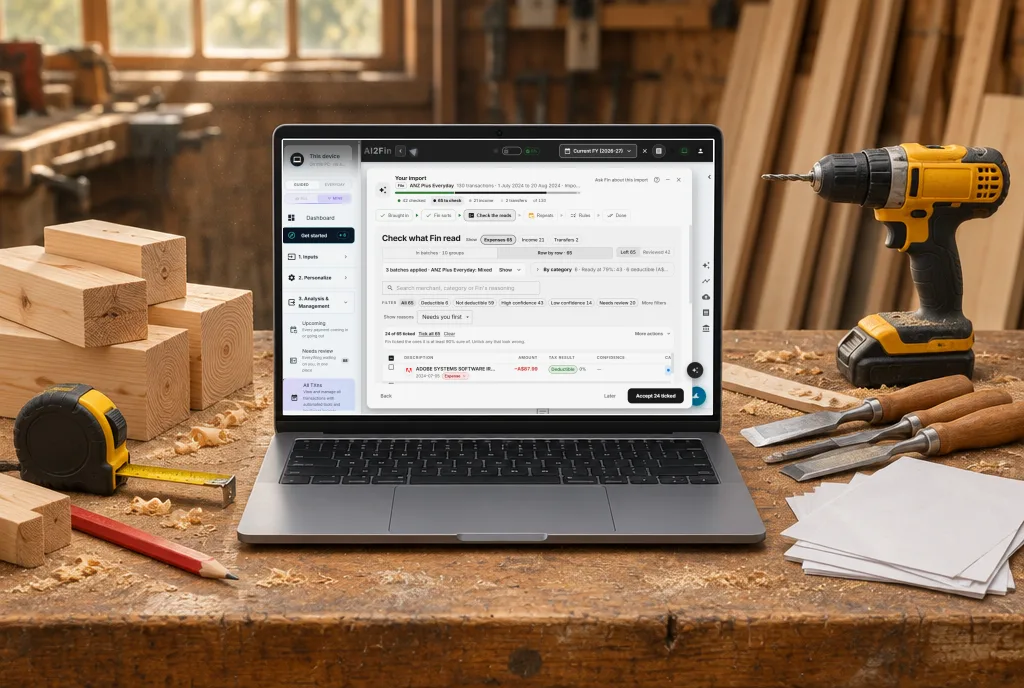
Catching up is mostly sorting, and sorting is the part 2Fin takes off you. Bring in two years of bank statements at once — CSV, Excel or PDF, several files in one go — and Fin reads every line; in testing, 1,891 transactions came in in about a second on a desktop computer. Each transaction is categorised with its GST or VAT worked out, every overdue quarter is listed with its due date, and Fill all periods saves a draft of each one with a single press.
What is left for you is the decisions, not the data entry. Purchases are grouped by payee — the timber yard, the tool shop, the fuel — so you answer each payee once and the answer covers every quarter. Fin’s confident guesses (80% sure or more) can be accepted in one tap and undone one by one, and a payee can become a rule so the next import sorts itself. Every figure opens to the transactions inside it, and the finished statements export for you or your agent to check and lodge.
Your income is already on file
Builders and head contractors who are primarily in building and construction report every payment to their subcontractors in a Taxable Payments Annual Report. If you were paid as a subbie, those payments are already with the ATO, year by year. Your catch-up BAS should account for the same income in the quarters you were paid; a bank file is the easiest way to make the two line up.
As a subcontractor you charge GST on your invoices once registered, and report and pay it on your BAS; the builder pays on your invoice.
Tools, timber and the credits behind them
A new drop saw, a nail gun or a trailer is a business purchase like the timber is: once registered, you claim the GST in 1B, at the business share. On Simpler BAS there is no separate capital purchases label to fill. Income tax treats tools differently (depreciation or an immediate write-off), which is your return’s business, not the BAS’s.
Keep tax invoices for anything over $82.50 including GST; a supplier has 28 days to provide one when you ask. This is general information. Check what applies to you with a registered tax or BAS agent, or with the tax office.
When you pay other chippies: your own TPAR
A subcontractor who is primarily in building and construction and pays other contractors lodges a TPAR too, for the people they pay. The test is whether building and construction is at least half of your business income or activity this year, or of your income last year. Report the full amount of an invoice that mixes labour and materials; leave out materials-only payments, employees and private home jobs.
Carpentry in the UK or New Zealand
In the UK, HMRC’s Flat Rate Scheme places joiners and carpenters in labour-only building or construction (14.5%) when materials are under 10% of turnover, otherwise general building or construction (9.5%); VAT registration starts at £90,000. In New Zealand, GST registration starts at $60,000 a year; see the New Zealand guide.
Take it further
Your quarterly GST position — 1A, 1B and the net amount payable, worked out for you.
2Fin for tradies →The glovebox receipts, already sorted
TPAR (Taxable Payments Annual Report) →The annual report of what you paid contractors in certain industries.
Tax invoice →The GST-compliant invoice that lets a buyer claim the GST back.
ABN (Australian Business Number) →The 11-digit number that identifies your business.
Common questions
Does the ATO know what builders paid me?
If the builders are primarily in building and construction, yes: they report each contractor’s payments in their Taxable Payments Annual Report, due 28 August each year. Your BAS sales for those years should account for the same income.
Can I claim the GST on a new set of power tools?
Yes, once you are registered, at the business-use share, with a tax invoice for anything over $82.50 including GST. On Simpler BAS the credit goes straight into 1B.
Do joiners and cabinet makers lodge a TPAR?
Cabinet making and joinery are on the ATO’s list of building and construction services, so a joiner who pays contractors for that work, and whose business is at least half building and construction, lodges a TPAR by 28 August.
I worked as a subbie without an ABN. What now?
Speak to the ATO or a registered agent before lodging anything: without an ABN, payers may have withheld tax, and whether you were a contractor or an employee changes what you owe and what they owed you. This is general information. Check what applies to you with a registered tax or BAS agent, or with the tax office.
Sources
- ATO — Taxable payments annual report — due 28 August
- ATO — TPAR: building and construction services — primarily building and construction (50% tests); painting, carpentry and finishing listed; last updated 23 Apr 2024
- ATO — Payments businesses need to report in their TPAR — mixed labour and materials reported in full; materials-only left out; last updated 20 Oct 2026
- ATO — When you can claim a GST credit — tax invoice needed over $82.50 including GST; business portion only; 4-year limit; last updated 14 Sep 2026
- ATO — Tax invoices — issue within 28 days on request; RCTI rules; last updated 18 Sep 2026
- ATO — GST reporting methods — Simpler BAS (G1, 1A, 1B) is the default under $10 million GST turnover
- ATO — About GST and motor vehicles — a “car” carries under one tonne and fewer than 9 passengers; last updated 29 May 2024
- ATO — Registering for GST — $75,000 threshold ($150,000 non-profit); taxi and ride-sourcing register regardless; 21 days; backdating generally limited to 4 years; last updated 14 Sep 2026
- GOV.UK — VAT Flat Rate Scheme: how much you pay — flat rate by trade; 16.5% for a limited cost business
- GOV.UK — Register for VAT — £90,000 over 12 months; register within 30 days; VAT due from the date you should have registered
- Inland Revenue — Registering for GST — $60,000 in 12 months; last updated 13 Feb 2025
General information computed from published government guidance, not personal tax advice.
More on catching up on overdue returns
Two years of overdue BAS is eight quarters. Lodge all of them, oldest first, even if you can’t pay: the ATO’s failure-to-lodge penalty is one penalty unit ($364 from 1 July 2026) for each 28 days late, capped at five for a small business, and a nil or refund BAS is generally not penalised. With 2Fin, eight quarters were prepared from a bank file for review in about 10 minutes of modelled person time. You or your BAS agent lodge.
Overdue BAS for painters: paint receipts, the ute and TPARA painter catching up on BAS needs three things straight: GST credits on paint and gear (with a tax invoice for anything over $82.50), the ute (one built to carry a tonne or more is not a “car”, so the car limit does not cap its GST credit), and the TPAR if you pay other painters — painting is a building and construction service, due 28 August. Cash jobs count as sales like any other.
Overdue BAS for tradies: the ute, cash jobs and catching upFor a tradie two years behind on BAS, the money is usually in the vehicle and the cash. A ute built to carry a tonne or more is outside the car limit, so its GST credit is the business share of the full GST; a car is capped at $6,353 for 2026–27. Cash jobs are sales and count toward the $75,000 threshold. Lodge every quarter oldest first, then set up a payment plan for what you can’t pay.
Job software, accounting software or expense tracking: what tradies actually needJob management quotes and schedules the work, accounting software keeps the ledger and files the returns, and expense tracking sorts what you spent. They are three different jobs, and how many you need moves with crew size and GST registration — except the expense side, which is worth having from the first week because it is what your deductions are built on.
Get your carpentry quarters prepared
Import your bank history free. Fin sorts the builders’ payments, timber and tools into each quarter for you to check.
Get 2Fin free →Back to all guides, or explore the glossary.