Overdue BAS for rideshare drivers: registered from the first trip
Rideshare drivers must be registered for GST before their first trip, whatever they earn: the $75,000 threshold does not apply to ride-sourcing. A driver who started without registering may owe GST on every fare since day one, so registration comes first in a catch-up. You report monthly or quarterly, not annually, and the car’s GST credit is capped by the car limit and cut to business use.
Import and categorise free. Preparing the BAS is on ELITE+ and AUTO+. 2Fin prepares the figures; you or your BAS agent lodge them with the ATO.
Rideshare GST, line by line
From the ATO’s pages, read on 12 November 2026.
| Situation | What applies | Source |
|---|---|---|
| Registration | Before your first trip, regardless of turnover | ATO, ride-sourcing registrations |
| Reporting | Monthly or quarterly BAS; annual GST reporting is not available | ATO, ride-sourcing registrations |
| Already registered for other work | The existing registration covers ride-sourcing too | ATO, ride-sourcing registrations |
| The car | Credit capped at $6,353 for 2026–27, then the business-use share | ATO, purchasing a motor vehicle |
| Fuel | GST credit at business use; fuel tax credits do not cover light vehicles on public roads | ATO, ride-sourcing registrations |
| Registered late | GST may be owed on fares from the date you should have registered; backdating generally up to 4 years | ATO, registering for GST |
Let 2Fin do the boring bits
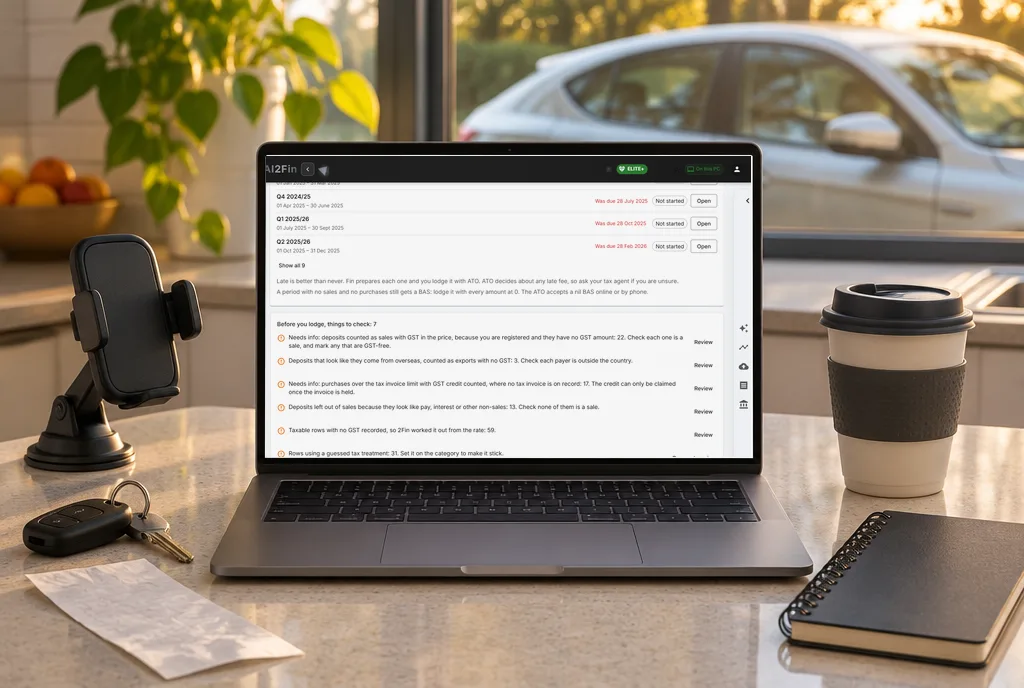
Catching up is mostly sorting, and sorting is the part 2Fin takes off you. Bring in two years of bank statements at once — CSV, Excel or PDF, several files in one go — and Fin reads every line; in testing, 1,891 transactions came in in about a second on a desktop computer. Each transaction is categorised with its GST or VAT worked out, every overdue period is listed with its due date, and Fill all periods saves a draft of each one with a single press.
What is left for you is the decisions, not the data entry. Purchases are grouped by payee — the fuel, the servicing, the phone plan — so you answer each payee once and the answer covers every period. Fin’s confident guesses (80% sure or more) can be accepted in one tap and undone one by one, and a payee can become a rule so the next import sorts itself. Every figure opens to the transactions inside it, and the finished statements export for you or your agent to check and lodge.
Registration comes first
Ride-sourcing counts as taxi travel for GST, so the usual $75,000 threshold does not apply: you need an ABN and GST registration before your first trip. If you already had an ABN, you register for GST within 21 days of starting. If you drove without registering, you may owe GST on fares from the date you should have registered, even though it was never added to them. Raise it with the ATO before lodging anything; backdating is generally limited to 4 years. This is general information. Check what applies to you with a registered tax or BAS agent, or with the tax office.
Give your ABN to the platform, which may issue tax invoices on your behalf.
The car, fuel and phone
A rideshare car is a car for GST, so its credit is capped at 1/11 of the car limit — $6,353 for 2026–27 — and then cut to the business-use share; keep a record of business use, such as a logbook. Fuel, servicing, cleaning and your phone follow the same business-use rule. Fuel tax credits are a separate scheme that does not cover light vehicles on public roads.
Take it further
Your quarterly GST position — 1A, 1B and the net amount payable, worked out for you.
2Fin for rideshare & delivery drivers →Every shift adds itself up
ABN (Australian Business Number) →The 11-digit number that identifies your business.
Logbook method (car expenses) →Claim your car’s real business-use share of running costs.
Apportionment →Dividing a shared cost so only the income-earning share is claimed.
Common questions
Do Uber drivers need to register for GST in Australia?
Yes, before their first trip, whatever they earn. Ride-sourcing is treated as taxi travel, so the $75,000 threshold does not apply, and you report monthly or quarterly.
I drove for a year without registering for GST. What do I do?
Contact the ATO, or a registered agent, before lodging anything. You may owe GST on fares from when you should have registered, and registration can generally be backdated up to 4 years. Telling the ATO first usually means lower penalties. This is general information. Check what applies to you with a registered tax or BAS agent, or with the tax office.
Can rideshare drivers lodge GST annually?
No annual option is available for ride-sourcing: drivers report GST monthly or quarterly on a BAS, even when their turnover is small.
Sources
- ATO — Ride-sourcing: registrations — register for GST before your first trip, whatever your turnover; monthly or quarterly only; last updated 20 Aug 2025
- ATO — Registering for GST — $75,000 threshold ($150,000 non-profit); taxi and ride-sourcing register regardless; 21 days; backdating generally limited to 4 years; last updated 14 Sep 2026
- ATO — Purchasing a motor vehicle (GST) — car limit $69,883 for 2026–27, maximum GST credit $6,353; commercial vehicles outside the limit; last updated 3 Jun 2026
- ATO — About GST and motor vehicles — a “car” carries under one tonne and fewer than 9 passengers; last updated 29 May 2024
- ATO — When you can claim a GST credit — tax invoice needed over $82.50 including GST; business portion only; 4-year limit; last updated 14 Sep 2026
- CRA — RC4022, General information for GST/HST registrants — $30,000 small supplier; 29 days to register; filing periods; file every period; 6 years of records
- GOV.UK — Register for VAT — £90,000 over 12 months; register within 30 days; VAT due from the date you should have registered
- Inland Revenue — Registering for GST — $60,000 in 12 months; last updated 13 Feb 2025
General information computed from published government guidance, not personal tax advice.
More on catching up on overdue returns
Two years of overdue BAS is eight quarters. Lodge all of them, oldest first, even if you can’t pay: the ATO’s failure-to-lodge penalty is one penalty unit ($364 from 1 July 2026) for each 28 days late, capped at five for a small business, and a nil or refund BAS is generally not penalised. With 2Fin, eight quarters were prepared from a bank file for review in about 10 minutes of modelled person time. You or your BAS agent lodge.
Taxi and rideshare fares for work: what the ATO lets you claimIn Australia a taxi or rideshare fare is generally claimable when the trip itself is part of the work: between two workplaces, to a client or job site, or to the airport for a work trip. The trip between home and your regular workplace generally is not, except in limited cases. You must have paid it yourself, and you need a record of why the trip was for work.
Overdue BAS for tradies: the ute, cash jobs and catching upFor a tradie two years behind on BAS, the money is usually in the vehicle and the cash. A ute built to carry a tonne or more is outside the car limit, so its GST credit is the business share of the full GST; a car is capped at $6,353 for 2026–27. Cash jobs are sales and count toward the $75,000 threshold. Lodge every quarter oldest first, then set up a payment plan for what you can’t pay.
Late GST/HST returns in Canada: penalties, relief and catching upThe CRA’s penalty for a late GST/HST return is 1% of the amount owing plus 0.25% of it for each full month late, up to 12 months; there is none when nothing is owing. Interest compounds daily (7% for October–December 2026). Since 1 October 2025 the Voluntary Disclosures Program gives 75% interest relief and 100% penalty relief to people who come forward before the CRA contacts them. File every period: refunds are held until all returns are in.
Get your rideshare periods prepared
Import your bank and platform history free. Fin sorts fares, fuel and the car into each period for you to check.
Get 2Fin free →Back to all guides, or explore the glossary.