





















How to Estimate Quarterly Taxes: A 2026 Walkthrough
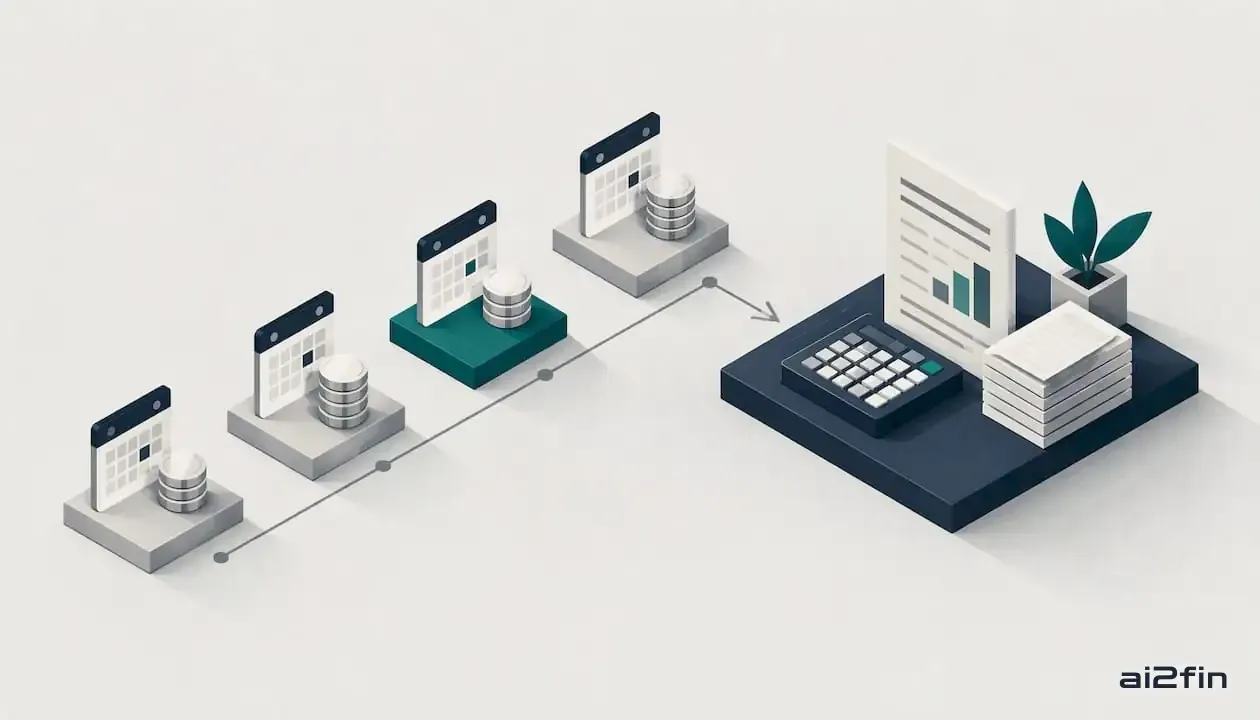
The path of quarterly estimated tax payments. Image: 2Fin (ai2fin.com).
To estimate quarterly taxes, project your income, deductions and credits for the year, work out the total tax you will owe, subtract what withholding already covers, and split the rest into payments. You can also skip the forecast and base your payments on last year's tax bill. Either route is legitimate, and the right one depends on how steady your income is. Below you will find both methods, a worked example, the dates that still matter this year, and a routine that keeps the estimate honest.
This guide covers U.S. federal estimated tax for 2026. State rules differ, so check your own state's revenue department before you pay.
Last reviewed October 2026. General information, not tax or financial advice.
TL;DR
- You generally need to pay estimated tax if you expect to owe at least $1,000 for 2026 after withholding and credits, and your withholding will fall short of the safe harbor amounts (IRS).
- Two methods work: pay 100% of last year's tax (110% for higher earners), or pay 90% of this year's projected tax. Pay whichever is smaller.
- If your income is lumpy or seasonal, the annualized method can lower early payments and protect you from penalties when income spikes late.
- After September 15, the one 2026 payment still ahead is due January 15, 2027.
- Move a fixed share of every payment you receive into a separate tax account, and re-run the estimate whenever your income changes.
Who actually has to make estimated payments
Taxes in the U.S. are pay-as-you-go. They have to reach the IRS as you earn or receive income, either through withholding from a paycheck or through estimated payments. If you are a W-2 employee with no other income, your employer handles this. The trouble starts when money arrives with no tax taken out: freelance invoices, sole proprietor profit, interest, dividends, rental income, or gains from selling investments.
The IRS rule of thumb is that you generally must make estimated payments if both of these are true:
- You expect to owe at least $1,000 in tax for 2026 after subtracting withholding and credits.
- You expect your withholding and credits to be less than the smaller of 90% of your 2026 tax or 100% of your 2025 tax. That second figure becomes 110% if your adjusted gross income (AGI) was over $150,000 ($75,000 if married filing separately).
Those two percentages are called safe harbors. Hit one of them and you should not face an underpayment penalty, even if the final bill turns out larger than you guessed.
A common mix is a day job plus a side business. In that case you may not need quarterly payments at all: you can raise your W-4 withholding at work to cover the side income. Withholding is treated as paid evenly through the year, which makes it a forgiving tool if you start the year thinking you were fine and realize in the fall that you were not.
The two ways to calculate your payments
There is no single "quarterly tax formula". There are two approaches, and they suit different people.
Method 1: Prior-year safe harbor
Take the total tax shown on your 2025 return, multiply by 100% (or 110% if your 2025 AGI was above $150,000), subtract any 2026 withholding you expect, and divide the rest by four. You do not have to forecast anything. That is the point.
The tradeoff is cash flow. If your income fell this year, you may pay more than you needed to and wait for a refund. If your income grew, you will owe a balance in April, but you should not owe a penalty. Fidelity's guide describes this method as the better fit for stable businesses.
Method 2: Current-year projection
Here you estimate your 2026 AGI, taxable income, tax, deductions and credits, which is the process the IRS describes for Form 1040-ES. Pay at least 90% of the projected total through withholding and estimated payments combined. You get a payment that tracks this year's reality, which helps if income dropped. The risk is that you underestimate. If your income grows during the year and you never revisit the projection, you can come up short.
Method 3: Annualized installments
If you earn unevenly, you can base each payment on the income you actually received up to that point in the year instead of assuming four equal quarters. Fidelity notes that the annualization method matters most for freelancers and seasonal businesses, and that ignoring it when income spikes mid-year is a leading cause of underpayment penalties. Think of a wedding photographer who earns most of her income from May to September, or a consultant who lands a large contract in August. Equal payments in April and June overstate what they owed at that point, and equal payments assumed for the late quarters can understate it.
The annualized route involves extra paperwork when you file, so use it when the uneven income is large enough to matter, and keep records by period.
| Situation | Method that usually fits | Main benefit | Main risk |
|---|---|---|---|
| Steady income, similar to last year | Prior-year safe harbor | No forecasting needed | Possible overpayment if income dropped |
| Income fell this year | Current-year projection | Lower payments | Underestimating if income rebounds |
| Income grew sharply | Prior-year safe harbor | Penalty protection with a smaller forecast burden | Larger balance due in April |
| Seasonal or lumpy income | Annualized installments | Payments match when you earned | More records and extra form work |
A worked example
The numbers below are illustrative, not drawn from any real taxpayer, and they use round figures to show the mechanics.
Say Dana is a freelance designer, single, with 2025 AGI under $150,000. Her 2025 return showed total tax of $9,000. For 2026 she expects total tax of $12,000 because a few large projects came in. She has no withholding.
- Prior-year safe harbor: 100% of $9,000 is $9,000, or $2,250 per quarter.
- Current-year method: 90% of $12,000 is $10,800, or $2,700 per quarter.
The safe harbor is the smaller of the two, so she needs to pay at least $9,000 across the year to avoid the penalty, which is $2,250 a payment. She will still owe the remaining $3,000 when she files, so she should set that aside too. Many people confuse "enough to avoid a penalty" with "enough to owe nothing in April". They are different targets.
Now suppose Dana only starts paying in September because she did not realize she was covered by the rules. She may not have caught up on the earlier due dates. Each payment period is measured on its own, so a large late payment does not necessarily erase a penalty for earlier periods. The IRS says that if you do not pay enough by each due date, you may be charged a penalty even if you are due a refund when you file.
Step by step: building your own estimate
- Start with last year's return. Find your total tax and AGI from 2025. This sets your prior-year safe harbor figure right away.
- Project income for 2026. Add year-to-date income, then add what you reasonably expect for the rest of the year. Use invoices, retainers and contracts, not hopes. For investment income, the IRS withholding tool suggests multiplying an average quarterly dividend by four to build a yearly figure.
- Subtract business expenses. Sole proprietors tax profit, not revenue. Missing expenses is the quickest way to overpay, so categorize costs as you go instead of at year end.
- Account for deductions and credits. Use the standard or itemized deduction you expect, plus credits you qualify for.
- Work out total tax. That includes income tax, and for self-employed people, self-employment tax on net earnings. The Form 1040-ES worksheets walk through this.
- Subtract withholding and credits. What is left is your estimated tax to pay.
- Compare against the safe harbors. Pay the smaller of 90% of this year or 100%/110% of last year.
- Divide by the number of payments left and schedule them.
If you want a quick federal sanity check before you do the full worksheet, this calculator gives a federal take-home estimate from your income:
Work out your US take-home pay
For the marginal-rate idea behind it, see the glossary entry on the marginal tax rate.
Due dates for 2026
The four estimated payment periods for 2026 fall on April 15, June 15, September 15, and January 15, 2027, according to the Form 1040-ES instructions. The periods are not four equal quarters of three months, which surprises many first-time payers.
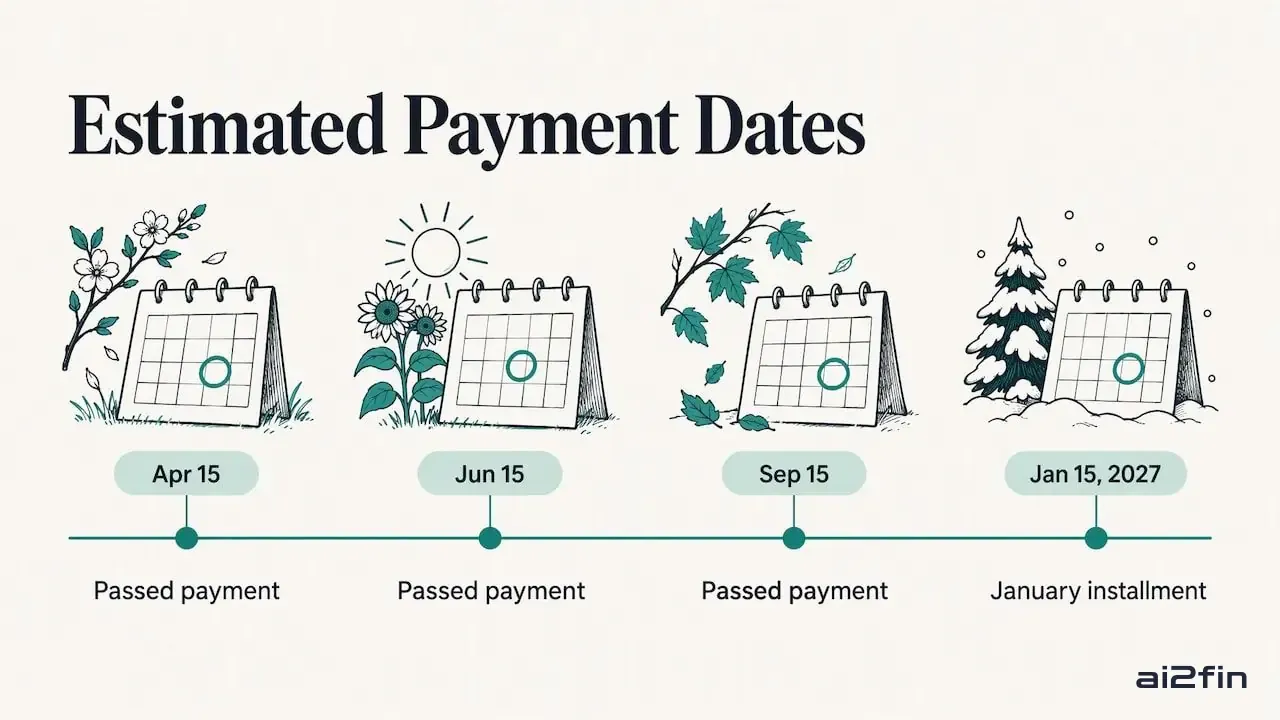
Federal estimated tax payment dates for 2026. Image: 2Fin (ai2fin.com).
From mid-September onward, the first three payments have passed. If you missed one, pay as soon as you can rather than waiting for the next date, because the penalty is figured by period.
The same instructions say you can skip the January payment if you file your 2026 return and pay the entire balance by February 1, 2027. That is useful if you prefer to file early with your records in order, but only if you are sure of the final figure.
Also confirm your state's dates, since many states mirror the federal schedule but not all do.
Keep the estimate alive all year
An estimate is not a one-time calculation. The Form 1040-ES guidance treats it as something you adjust when your circumstances change, such as business growth, new investments or a change in law. The most dangerous version is the payment you set in January and never look at again.
A simple rhythm works well:
- Weekly or biweekly: move a fixed percentage of each payment received into a separate savings account used only for taxes. This keeps you from spending money that belongs to the IRS.
- Monthly: categorize transactions and reconcile income and expenses.
- Before each due date: recompute year-to-date profit and compare it with the projection. If profit is running 20% ahead, raise the next payment.
- After any big event: a large client, a property sale, a business purchase, a move to a new state. Re-run the numbers right away.
If part of your income is rental or short-stay hosting, the timing of when money lands can differ from when you are billed, so review income as it arrives rather than as it is invoiced. The 2Fin Upcoming view lists every payment coming in or going out, which makes it easy to see whether the cash for the next due date is there. A rolling 90-day cash flow forecast answers the same question from the other direction.
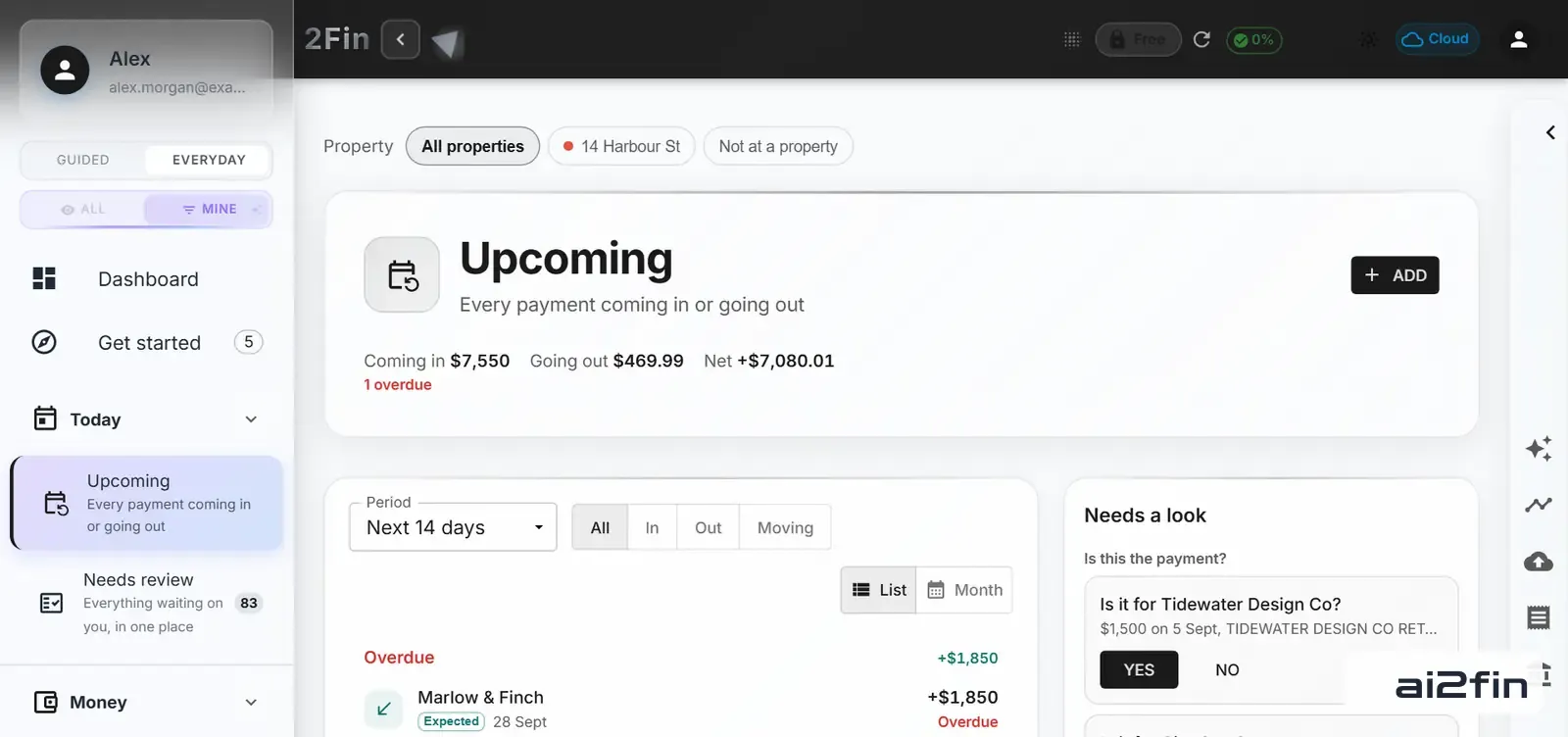
2Fin upcoming payments. Image: 2Fin (ai2fin.com).
Books that are always roughly current
Most people who get hit by underpayment penalties did not lack willingness to pay. They lacked a current picture of their numbers. The calculation itself is a few lines of arithmetic. The hard part is knowing, in October, what your profit really is, which requires every bank transaction to be categorized and every deductible expense to be caught.
That is why 2Fin starts with bookkeeping. When transactions are sorted automatically, separated between personal, business and rental use, and checked for deductions, the year-to-date profit an estimate needs is already sitting there. You are not reconstructing it from bank statements on the 14th of the month. Books that are always roughly current are the real fix for quarterly tax stress, more than a cleverer formula.
The cautious route is also the simple one. If you are unsure, use the prior-year safe harbor to protect yourself from penalties, then use your live numbers to decide how much extra to set aside for April. Pay what the rules require, save what your real profit suggests.
Making the numbers easier with 2Fin
If your estimate depends on messy exports and a spreadsheet you rebuild every quarter, 2Fin can take over the sorting. It also accepts receipt uploads and exports to Google Sheets and Excel. The plans page lists what each tier includes, and how 2Fin works shows the path from bank import to tax-ready books. Related guides: freelancer tax deductions, freelance expense tracking and what your accountant needs at tax time.
Mistakes that trigger penalties
- Treating filing and paying as one event. Filing is annual. Payment is spread across the year, and each payment date is judged separately.
- Setting the amount once. If income grows mid-year, prior-year-based payments on their own may leave you with a bigger bill, and projection-based payments may be too low.
- Counting revenue instead of profit. Forgetting deductible costs inflates your estimate. Forgetting self-employment tax deflates it.
- Spending the tax share. The cash is real, and it is easy to treat as yours. A separate account fixes this. HMRC data points the same way abroad: about one in five self-assessment bills is paid late, often because the bill arrives long after the income did.
- Ignoring the state. Federal safe harbors do not settle state estimated tax.
If you are outside the U.S.
Other countries run their own systems, and the details differ. In the UK, payments on account are two instalments, each half of last year's bill, due on 31 January and 31 July. In Australia, PAYG instalments are generally due 28 days after each quarter ends; the glossary entry on PAYG explains withholding versus instalments, and how BAS lodgement works covers the quarterly cycle. If you are in Australia, the BAS calculator covers the quarterly GST side, and the UK income tax calculator does the same job for the UK. None of those rules apply to a U.S. return.
Frequently asked questions
Who has to pay quarterly estimated taxes?
Generally you must pay estimated tax if you expect to owe at least $1,000 for 2026 after withholding and credits, and your withholding and credits will be less than the smaller of 90% of your 2026 tax or 100% of your 2025 tax (110% if your 2025 adjusted gross income was over $150,000).
How much should I set aside for estimated quarterly taxes?
For a rough start, many freelancers set aside a fixed share of every payment they receive and adjust once they have a real projection. The right share depends on your income, deductions and state, so calculate it from the worksheets rather than copying a flat percentage. If you are unsure, a CPA or enrolled agent can set your figure in one session.
When are estimated quarterly taxes due in 2026?
The 2026 due dates are April 15, June 15, September 15 and January 15, 2027, per the Form 1040-ES instructions. The January payment can be skipped if you file your return and pay the full balance by February 1, 2027.
Do I have to use equal payments?
Not necessarily. The default is four equal amounts, but if your income is uneven, the annualized method lets payments follow when you earned the money. It takes more record keeping, so it makes the most sense when income swings widely between periods.
What if I missed a payment this year?
Pay as soon as you can. The IRS calculates penalties by payment period, so paying late is better than not paying. Once you have caught up, recalculate your projection so the January payment reflects your real position, and consider a tax professional if the shortfall is large.
How does 2Fin help with quarterly taxes?
Estimates depend on knowing year-to-date profit. Fin sorts every transaction as it arrives, separates personal, business and rental costs, and keeps income and expenses current, so the numbers you need are already in one place. You can start on the free plan.
