

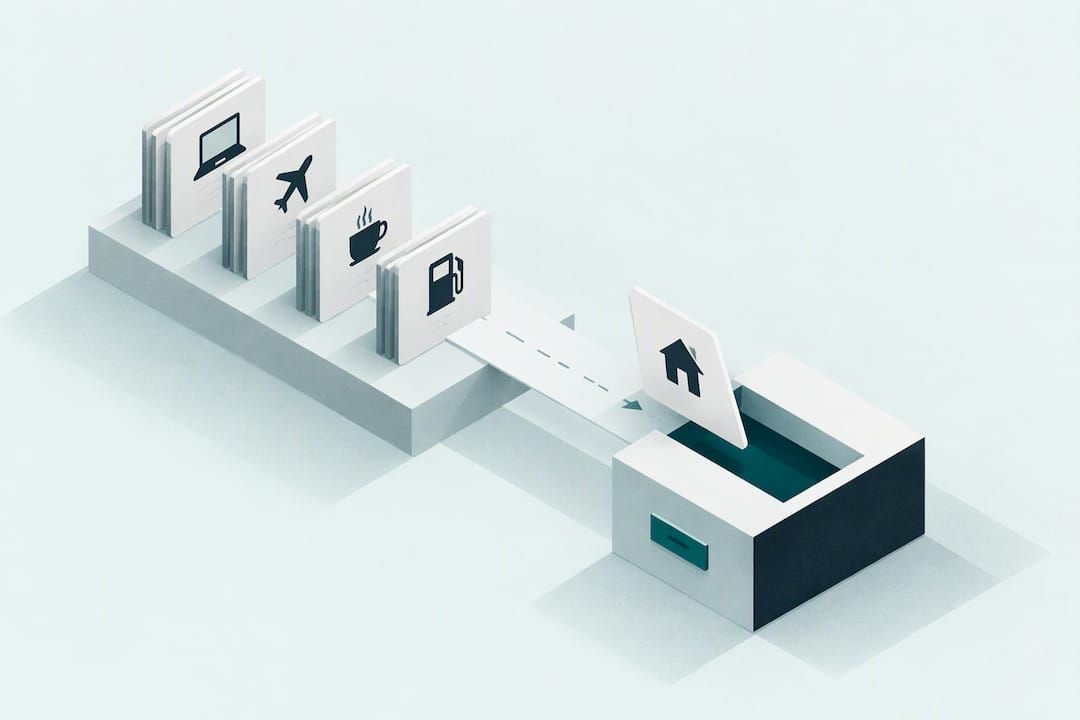
Yes. As a US freelancer you can deduct ordinary and necessary business expenses, and the biggest wins are home office costs, vehicle mileage, equipment, health insurance, and retirement savings. The deductions land in different places on your return (Schedule C, above-the-line adjustments, or the qualified business income deduction), so what matters most is keeping contemporaneous records the moment an expense happens, not scrambling for receipts in April.
TL;DR:
- The simplified home office method allows $5 per square foot, capped at 300 square feet; the space must be used regularly and exclusively for business.
- The 2026 mileage rate is 72.5 cents through June 30 and 76 cents from July 1; log each trip’s date, miles, and business purpose.
- Schedule C expenses reduce income and self employment taxes; health insurance and retirement deductions lower adjusted gross income, but not self employment tax.
- Keep receipts tied to transactions, review categorized expenses monthly, and retain records for at least three years after filing; separate business spending from personal purchases.
What can freelancers deduct? A category-by-category checklist
If you are new to the terms, your marginal tax rate is what decides how much each deduction is worth. The IRS test behind nearly every deduction on this list comes from IRC Section 162: an expense has to be ordinary (common in your line of work) and necessary (helpful for running your business) to qualify. That standard is broad, but it still excludes personal spending that happens to touch your work. Here is how it plays out across the categories freelancers run into most.
- Home office. You can use the simplified method ($5 per square foot, up to 300 square feet) or the actual expense method, which prorates rent, utilities, insurance, and repairs by the percentage of your home used for work. Either way, the space has to pass the "regular and exclusive" test: it is used only for business, consistently, not a kitchen table you also eat dinner at. Keep a measurement of the office square footage against your home's total square footage, plus utility bills and a lease or mortgage statement if you use the actual method.
- Vehicle and mileage. You choose once per vehicle, per year, between the standard mileage rate and actual expenses (gas, repairs, insurance, depreciation). The IRS set the 2026 standard business mileage rate at 72.5 cents per mile for travel from January 1 through June 30, 2026, rising to 76 cents per mile for travel on or after July 1, 2026. Whichever method you pick, a contemporaneous log recording the date, starting and ending odometer readings or miles driven, and the business purpose of the trip is what survives an audit.
- Equipment and technology. A laptop, camera, monitor, or external drive bought for work can often be expensed in full the year you buy it under Section 179, rather than depreciated over several years, subject to limits on total qualifying purchases and your business income for the year. Larger or longer-lived assets may still need to be depreciated under MACRS schedules instead of expensed immediately, so check the asset's class life before assuming full first-year write-off.
- Software and subscriptions. Recurring SaaS costs (invoicing tools, design software, cloud storage, project management apps) are deductible as ordinary business expenses in the year paid. Record each subscription against the business bank or card statement that paid it, since recurring charges are the easiest category to lose track of by December (spotting recurring patterns automatically helps).
- Professional services and contractor payments. Fees paid to accountants, lawyers, designers, or subcontractors are deductible, and if you pay a contractor $2,000 or more during 2026 (up from $600 in earlier years) you generally need to issue them a Form 1099-NEC. Keep invoices and proof of payment (bank transfer confirmation, canceled check, or payment platform receipt) matched to each vendor.
- Self-employed health insurance. If you are not eligible for an employer-subsidized plan through a spouse's job, you can generally deduct premiums for medical, dental, and qualified long-term care insurance for yourself, your spouse, and dependents. This is an above-the-line deduction calculated on Form 7206, which walks through net profit limits and other adjustments before you carry the result to Schedule 1.
- Retirement plan contributions. A Solo 401(k) or SEP IRA lets you shelter a meaningful share of self-employment income, with the allowable amount calculated after adjustments like half of your self-employment tax, per the worksheets in IRS guidance on self-employed retirement contributions. The deduction is claimed as an above-the-line adjustment, not on Schedule C.
- Business travel and meals. Travel that requires an overnight stay away from your tax home qualifies as business travel under IRS Publication 463, covering airfare, lodging, and incidentals. Meals during that travel, or meals with clients discussing business, are generally 50% deductible, and you need a receipt plus a note on who attended and what was discussed.
- Advertising, insurance, fees, and professional development. Paid ads, business liability insurance, bank and payment processing fees, coworking memberships, professional association dues, and courses or certifications tied to your work all qualify as ordinary expenses. Each needs only a receipt or statement tying it to the business.
- Commonly missed items. Postage, parking and tolls on business trips, merchant processing fees, small tools under your capitalization threshold, and annual license or permit fees quietly add up and are frequently left off Schedule C because no single receipt feels big enough to track.
Pro Tip: Set a recurring monthly reminder to export your business bank and card statements and tag anything that does not already have a matching receipt. That one habit catches more missed deductions than a year-end scramble ever will.
How deductions actually lower your tax bill
Not all deductions work the same way, and understanding where each one lands changes how you prioritize your bookkeeping.
- Schedule C deductions reduce your net business profit, which lowers both your income tax and your self-employment tax, since self-employment tax is calculated on net earnings from self-employment, making Schedule C write-offs the most valuable dollar for dollar.
- Above-the-line deductions, like self-employed health insurance and retirement contributions, reduce your adjusted gross income (AGI) but do not reduce your net self-employment earnings, so they lower your income tax without touching your SE tax bill.
- Half of your self-employment tax is itself an above-the-line adjustment taken on Schedule 1, which prevents you from paying income tax on the employer-equivalent share of SE tax you already paid.
- The qualified business income (QBI) deduction under Section 199A can let eligible freelancers deduct up to 20% of qualified business income, though the calculation and eligibility phase out at higher income thresholds and depend on the type of work you do.
To see the difference, take a freelancer in the 22% bracket. A $1,000 Schedule C deduction saves about $220 of income tax plus about $141 of self-employment tax (15.3% on 92.35% of the $1,000), roughly $360 in all. A $1,000 above-the-line deduction (like a health insurance premium) saves only the $220 of income tax, because it never touches the self-employment earnings base. (The deductible half of SE tax and the QBI deduction shave these figures slightly, but the gap holds.) That distinction is why Schedule C categories deserve the closest attention when you are deciding where to focus your recordkeeping effort.
Check your federal bracket and take-home pay
Build a recordkeeping system that survives an audit
The IRS recordkeeping guidance for small businesses (Publication 583) is blunt: you need to prove your deductions, and the records have to exist close to when the expense happened, not reconstructed later from memory.
- Mileage log: record the date, starting and ending odometer reading or total miles, and the specific business purpose of each trip, logged the day of or within a few days.
- Receipt capture: photograph or scan every receipt the day you get it (a simple receipt system makes this stick) and link it to the matching bank or card transaction, which is far easier when your business spending runs through a dedicated account.
- Split costs: for phone, internet, or home office expenses used for both personal and business purposes, calculate a defensible percentage (business minutes used, or square footage of the office versus the whole home) and apply that percentage consistently every month.
- Retention: keep records for at least three years from the date you file, longer if you underreported income or claimed a loss, and review your categorized expenses monthly rather than waiting until filing season.
Pro Tip: A business-only checking account and card, even for a one-person operation, removes the single biggest source of audit risk: the "was that for the business or for me" question that comes up every time personal and business spending share one account.
Where to report each deduction on your tax return
Mapping deductions to the right form avoids a common and avoidable filing error.
- Schedule C lines carry most of the deductions above: advertising on line 8, car and truck expenses on line 9, legal and professional services on line 17, office expense on line 18, and supplies on line 22, with a dedicated line for home office expense that flows in from Form 8829 if you use the actual expense method.
- Schedule SE calculates your self-employment tax from the net profit figure on Schedule C, and half of that calculated tax becomes an adjustment on Schedule 1 of Form 1040.
- Form 7206 calculates your self-employed health insurance deduction, which then flows to Schedule 1 as an above-the-line adjustment, separate from anything reported on Schedule C.
- Form 8829 is required only if you use the actual expense method for home office; the simplified method skips this form and goes straight onto Schedule C.
- If you discover a missed deduction after filing, an amended return (Form 1040-X) can usually be filed within three years of the original filing date, and a tax professional is worth consulting whenever a correction touches more than one tax year or affects your retirement contribution limits.
Worked examples and an automation checklist
A freelancer who drove 1,200 business miles between January and June 2026 and logged each trip's date, mileage, and purpose can claim 1,200 miles at 72.5 cents per mile, a deduction of $870. Another 1,000 miles driven from July 1 onwards is valued at 76 cents per mile, adding $760, which is why the log needs dates and not just a yearly total. For home office, a 150-square-foot office under the simplified method deducts a flat $750 (150 x $5), while the actual expense method might deduct more or less depending on your actual rent, utilities, and repair costs for that same square footage, so it is worth calculating both before you file.
Automating the capture behind these numbers is where most freelancers lose deductions without noticing:
- Set bank rules that auto-tag recurring vendors (software, insurance, coworking) the moment a transaction posts.
- Upload receipts as soon as they arrive instead of batching them for later.
- Review and confirm category rules monthly so new vendors do not sit miscategorized for months.
- Reconcile bank and card statements against your bookkeeping monthly, not quarterly.
- Export a clean, categorized report to your accountant before filing season instead of during it (here is what your accountant needs at tax time).
Pro Tip: The categories that get missed most, bank fees, small postage charges, and one-off software trials, are exactly the ones a bank-rule automation catches that manual entry rarely does.
The three changes that matter most this year
Most freelancers do not lose deductions because the rules are complicated. They lose them because the documentation never gets created in the first place.
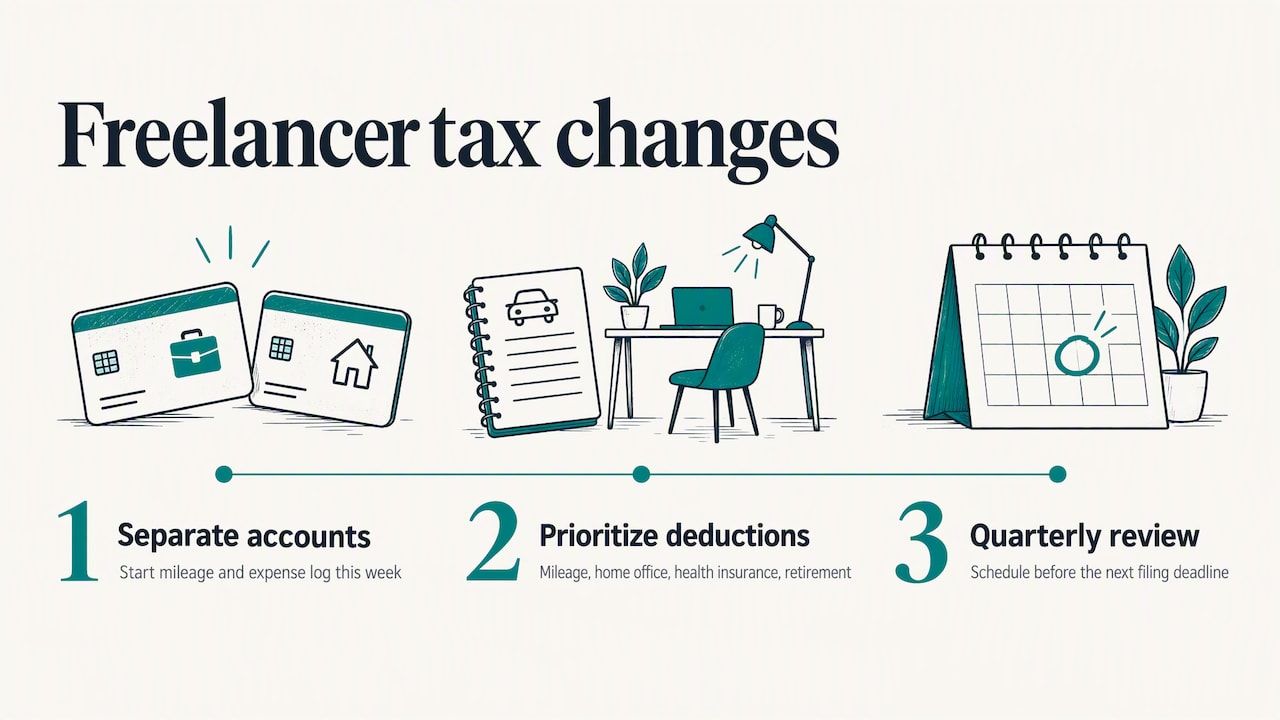
If you make one change this year, separate your business and personal spending into their own accounts and start a contemporaneous mileage and expense log the same week you read this. If you make two, prioritize the deductions with the biggest leverage first: mileage, home office, health insurance, and retirement contributions, in that order, since those four cover most of what freelancers actually underclaim. If you make three, put a quarterly review on your calendar now, before the next filing deadline sneaks up on you.
Deduction guides for your kind of freelance work
The categories above apply to almost every US freelancer, but the details change with the work. 2Fin has occupation guides for designers and digital freelancers, content creators, online sellers and streamers and gamers, plus the full list of US guides and a US tax overview.
Freelancing outside the US? The rules differ by country. See the designer and freelancer guides for Australia, the UK, Canada, India, New Zealand, Singapore and the UAE, or compare tax across countries.
How 2Fin helps freelancers capture every deduction
2Fin is built around the exact problem this article describes: deductions get missed not because freelancers do not know the rules, but because nobody has time to log every receipt by hand. Fin categorises transactions as they land, marks the ones that look tax-deductible, and keeps a running, accountant-ready export so nothing waits until April.
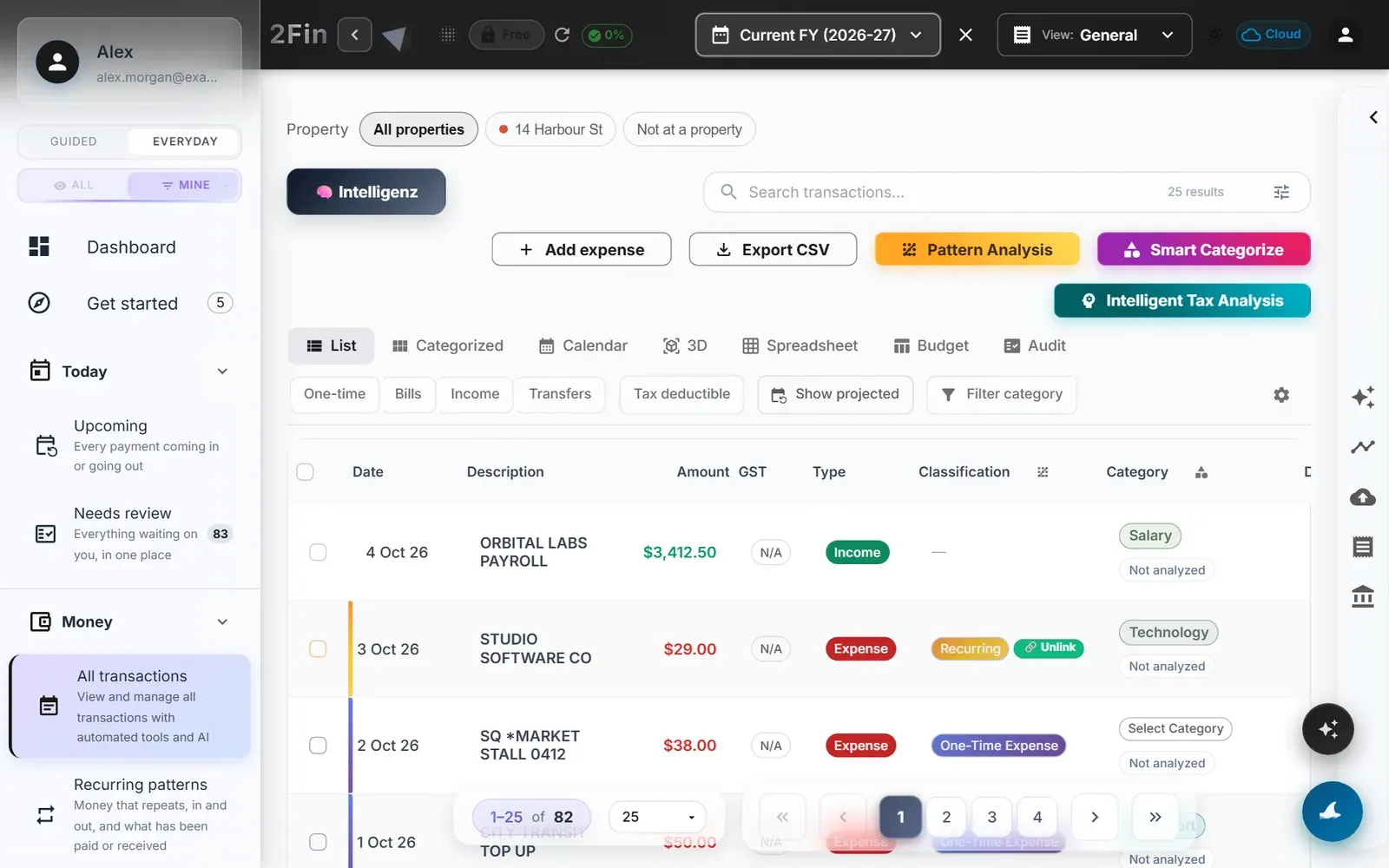
- Bank feeds and statement imports bring transactions in, and your rules sort recurring vendors (software, insurance, coworking) the moment they post.
- Receipt uploads, bulk transaction processing and business-use percentages cover the personal versus business splitting that home office, phone and vehicle costs need.
- Tax-ready exports give your accountant categorised, matched figures directly, cutting the back-and-forth that usually eats up filing season.
Start free with 2Fin: connect your business account and Fin starts sorting this year's deductions straight away. The free plan covers core categorisation; paid plans add deeper automation and tax tools (see plans).
This article is general information about US federal tax rules, not tax advice. Rules and limits change, and state rules differ, so check your own circumstances with a qualified tax professional (a CPA or enrolled agent) before acting on anything here.
FAQ
How much can I write off as a freelancer?
There is no fixed cap on freelancer deductions overall. Your write-offs are the total of every ordinary and necessary business expense you can document, which commonly includes home office costs, mileage, equipment, software, insurance, and retirement contributions, each governed by its own rules and limits.
What is the 20% deduction for self-employed?
That refers to the qualified business income (QBI) deduction under Section 199A, which can let eligible freelancers deduct up to 20% of their qualified business income. Eligibility and the exact calculation depend on income thresholds and the type of work performed, so the deduction is not automatic for every freelancer at every income level.
What expenses are 100% tax deductible?
Most ordinary business expenses paid entirely for business purposes, like software subscriptions, advertising, professional fees, and bank or processing fees, are fully deductible when they have no personal use. Expenses with mixed personal and business use, like a phone or home office, are deductible only for the business-use percentage, not the full amount.
What is the 2026 IRS mileage rate for self-employed people?
The 2026 standard business mileage rate is 72.5 cents per mile for driving from January 1 to June 30, 2026, and 76 cents per mile from July 1, 2026, after a mid-year increase. Apply the rate that matches the date of each trip, which is why a dated mileage log matters.
Do I need to send a 1099 to contractors in 2026?
For payments made in 2026, the Form 1099-NEC threshold rose to $2,000 per contractor for the calendar year, up from $600. If you paid a contractor $2,000 or more for services in 2026, you generally need to issue a 1099-NEC.
How do I get the biggest tax refund when self-employed?
The biggest lever is claiming every deduction you are entitled to, which starts with contemporaneous mileage logs, receipt capture, and correctly choosing between the simplified and actual home office methods. Pairing Schedule C deductions with above-the-line items like retirement contributions and self-employed health insurance, where you qualify, captures savings in both self-employment tax and income tax.
Recommended
Stay updated with 2Fin
Get the latest insights on intelligent financial management delivered to your inbox.
