





















Was That Uber for Work or Personal? Let the Receipt Answer
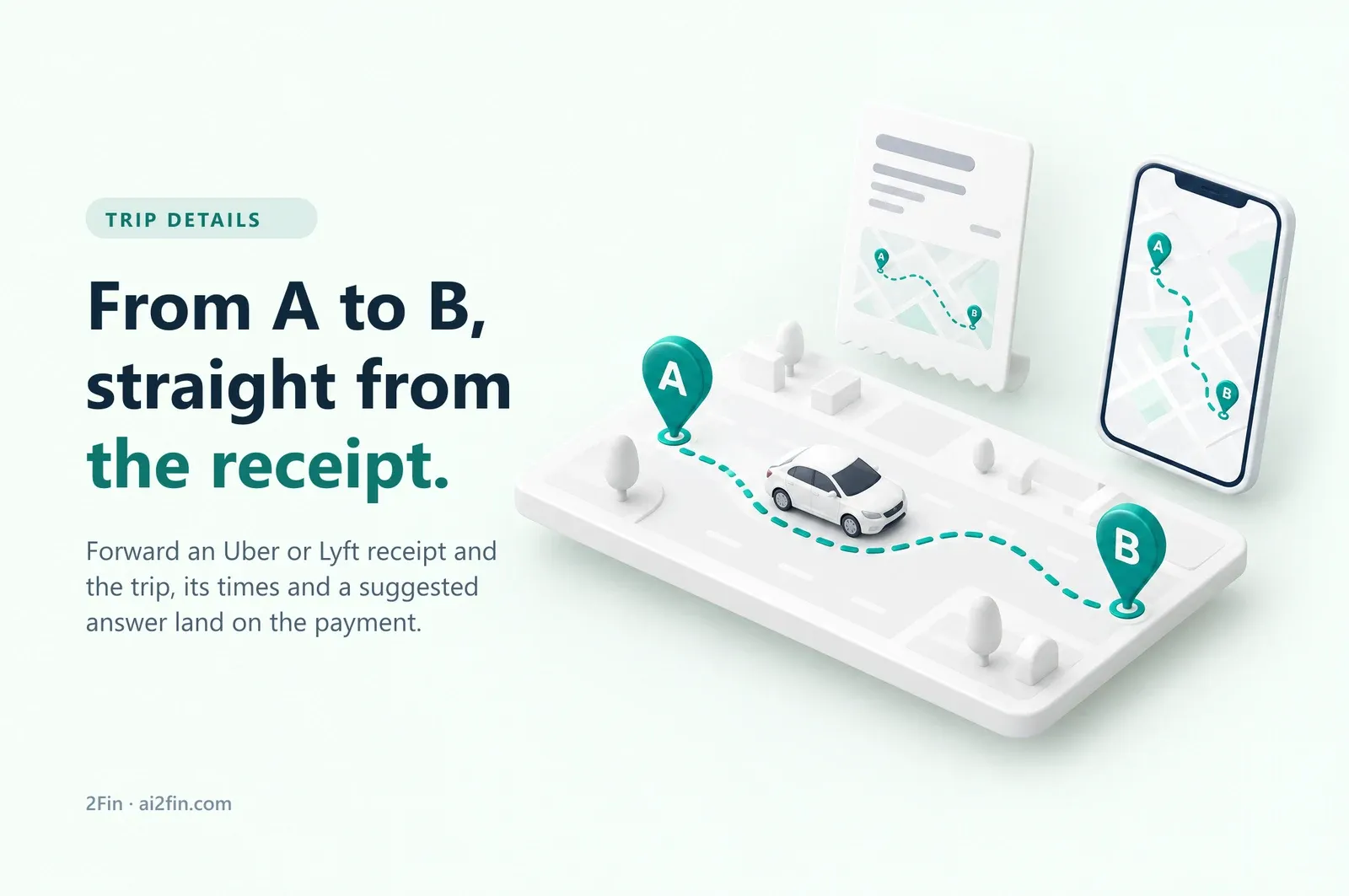
A ride, its receipt and its route, side by side. Image: 2Fin (ai2fin.com).
An Uber fare is generally a work expense when the ride took you between two work places, or to a client, and generally not when it took you from home to your regular workplace. The hard part is remembering where each ride went months later, because your bank line only says "uber trip". The receipt Uber emails you has the pick-up, the drop-off and the time. Forward it to 2Fin and Fin matches it to the payment, shows the trip with both ends, and asks the one question that matters: work, personal, or a share.
Last reviewed November 2026. General information, not tax advice. Rules differ by country, and the examples below follow Australian guidance.
The problem: a payment with no story
Your statement says "UBER* TRIP" and an amount. Three months on, at tax time, you are asked whether it was for work. You cannot remember. Guessing high is a risk. Guessing low leaves a legitimate claim on the table.
The story is already in your inbox. Every Uber and Lyft receipt lists where you were picked up, where you were dropped off and when.
What generally counts, in plain words
- Between two work places, or to a client or job site: generally deductible.
- From home to your regular place of work: generally treated as private commuting, so generally not deductible. The Australian Tax Office lists this among the trips you can't claim, with limited exceptions such as when home is a base of employment or you carry bulky tools.
- A mixed trip: a share, not an all-or-nothing answer.
- Records: keep the receipt and a short note of the purpose. Fin writes the note from the answer you give.
ATO Taxation Ruling TR 2021/1 sets out when travel between work locations is deductible. If your situation is unusual, check with your tax authority or a registered adviser.
How it works in 2Fin
- Forward the receipt. Send any Uber or Lyft receipt to your personal 2Fin receipts address, which you can find in the app. Mail sent from the email address on your 2Fin account is applied straight away. Mail from any other address is held for you to confirm.
- Fin recognises it. Fin sees the sender and the wording ("your trip", "trip fare"), reads the receipt, and matches it to the card payment by amount and date.
- See the trip. On the payment, Fin shows From and To with the times, plus distance and duration when the receipt has them.
- See the map. When the place lookup is switched on, a small map shows both ends with an A and a B. With it off, the card still shows both addresses and an "Open route in Maps" link.
- Answer once. Choose Personal, All for work or A share. The reason is saved with the payment as the trip purpose record.
How the detection works
- Who sent it. Fin looks at the sender's domain and the wording in the email to decide it is a ride receipt.
- The addresses. The pick-up and drop-off are read by fixed rules running on 2Fin's own servers. They are not sent to a language model.
- Amounts and dates. On other receipts and attachments, these can be read with the intelligent reader, only when "Intelligent insights" is on in your settings. With it off, only the rule-based reader runs. Card numbers, email addresses and phone numbers are removed from receipt text before it is read.
- The map. When the place lookup is on, each address is sent once to OpenStreetMap to find its point, and only when you open that ride. 2Fin remembers the answer under a one-way fingerprint of the address, not the address itself. You can switch the lookup off, and Airplane mode stops it.
- Only when sure. Fin draws a pin only when the place is clear. If it is not, you see the words and no pin. The line between A and B is straight, because the road taken is not known.
What about connecting to Uber directly?
There is no consumer Uber API for ride history. Uber's business receipts API is available to Uber for Business Enterprise clients and works at organisation level, so personal trips are not included. Forwarding the receipt email works for anyone, needs no Uber login, and keeps the connection in your hands.
Frequently asked questions
Is an Uber ride tax deductible?
Generally yes when it takes you between work places or to a client, and generally no for the commute from home to your regular workplace. A mixed trip can be claimed as a share. This is general information, not advice.
What do I need to keep for an Uber work trip?
The receipt, the date, where you went and why. 2Fin keeps the receipt with the payment and saves your answer as the purpose record.
Can 2Fin read my Uber receipts?
Yes. Forward the Uber or Lyft email to your 2Fin receipts address. Fin matches it to the payment and shows the trip.
Does 2Fin connect to my Uber account?
No. There is no consumer Uber API for ride history, and Uber's business API is for enterprise customers. Forwarding the receipt email works for anyone and needs no login to Uber.
Does this work for Lyft or other ride apps?
Uber and Lyft receipts show their trip details. Other apps can be forwarded too and are read as ordinary receipts (amount, date, merchant), but their trip details are not shown yet.
Is my home address safe?
Addresses are read by rules on 2Fin's own servers, not by a language model. The map lookup is optional, and sends one address at a time to OpenStreetMap only when you open that ride.
Is Uber Eats a trip?
No. Uber Eats is a delivery order, so it is read as a food receipt and shows no route.
Try it
Forward your next Uber receipt to 2Fin and let Fin answer the "where did that go?" question for you. Start with 2Fin free.
