






















A fixed asset register is an authoritative, controlled record of a business’s long-term physical assets that does three jobs at once: it is the financial record of cost and depreciation, a control document showing what you own and where it is, and the evidence you need for reporting, tax claims and insurance. Standards like IAS 16 and statutory rules such as the UK Companies Act shape what belongs in it. This guide covers the fields to record, how depreciation schedules work (with two worked examples), and the checks that make a register hold up at audit.
TL;DR:
- Record each asset’s full cost, including freight and installation, its service start date, and a unique ID that is never reused after disposal.
- Build purchase, maintenance, transfer and disposal updates into routine workflows; otherwise the register drifts out of sync before the next annual count.
- Reconcile every asset against a physical count at least once a year, and attach service reports, certificates and warranty documents to each record as audit evidence.
- IAS 16 requires useful life and residual value to be reviewed at least at each financial year end, so keep both editable rather than fixed at purchase.
- Move beyond spreadsheets when physical counts keep disagreeing, transfers become hard to track, or multiple sites make location and custodian records unreliable.
What should a fixed asset register include?
A usable register groups information into three clusters, and leaving any one out weakens the record. The first cluster establishes identity: what the asset is and where it sits. The second ties the asset to your books. The third answers the maintenance and compliance questions an auditor or insurer might ask.
- Identity fields: asset ID, name or description, category, physical location, custodian or assigned user, serial number, and the cost centre or project it belongs to if you track costs that way.
- Financial fields: purchase date, full cost basis (price plus freight and installation), placed-in-service date, depreciation method, useful life (effective life in Australia), residual value, accumulated depreciation and net book value.
- Operational and compliance fields: warranty details, service history, maintenance frequency, disposal date and proceeds, and a barcode or QR tag reference.
An asset register template published by Indigenous Business Australia lists these same categories, which makes it a reasonable reference structure. The financial fields are the ones depreciation calculations draw on directly, so getting the cost basis and placed-in-service date right at entry saves rework later.
Why keep a fixed asset register?
A well-kept register pays off in four distinct ways, and each one compounds as your asset base grows.
- Financial reporting accuracy: depreciation schedules feed directly into balance sheet figures, so a clean register means fewer year-end adjustments.
- Tax and insurance evidence: the register backs up depreciation claims and gives insurers a documented basis for valuing a loss.
- Operational control: knowing what you own, where it is and who holds it cuts down on loss, theft and duplicate purchasing.
- Time savings: automating entry and depreciation maths removes the manual recalculation that otherwise happens every year end.
The common thread is that a register is only as useful as it is current. A register that is accurate on paper but out of date in practice fails at the exact moment you need it, during an audit or a claim.
How do you create and maintain a fixed asset register?
Building a register is a one-time project, but keeping it accurate is an ongoing discipline built into how you buy, use and retire assets.
- Define scope. Decide which assets qualify, typically anything above a cost threshold with a useful life beyond one year (a capital purchase rather than an everyday expense).
- Run a physical inventory. Walk the premises, confirm what exists, and note condition and location for every item, including assets kept at a rental property, home office or vehicle.
- Assign unique IDs. Tag each asset with an ID that never gets reused, even after disposal.
- Capture core fields. Record identity and financial fields for every asset before moving to the next step. Past purchases are easiest to find in your bank history, so bring in the full history rather than just this year.
- Record new purchases before they go into service. Enter the full cost basis, including delivery and installation, as soon as the purchase is confirmed.
- Log lifecycle events as they happen. Maintenance, transfers between locations, impairments and disposals all need a dated entry, and a disposal entry should capture proceeds and the resulting gain or loss (a balancing adjustment in Australian tax terms).
- Build update triggers into procurement and maintenance workflows. New purchase orders and completed service tickets should push data into the register automatically or as a standard step, not as an afterthought.
- Schedule an annual reconciliation. Match the register against a physical count at least once a year, ideally at financial year end.
Pro Tip: Set your annual reconciliation date to match your financial year end so depreciation reviews and physical counts happen in the same pass.
The biggest point of failure is step 7. Registers that rely on someone remembering to update them after the fact drift out of sync.
How do you build a depreciation schedule?
Depreciation spreads an asset’s depreciable base, cost minus residual value, across its useful life. Each year’s depreciation expense reduces the asset’s book value and adds to accumulated depreciation, until the asset reaches its residual value or is disposed of. A schedule links the years in sequence: the opening book value feeds that year’s expense, which produces the closing book value, which becomes next year’s opening balance.
| Method | Expense pattern | Best for | Australian tax equivalent |
|---|---|---|---|
| Straight-line | The same amount every year | Assets with steady, predictable use, such as furniture | Prime cost |
| Declining balance | Heavier early, lighter later | Assets that lose value fastest when new, such as vehicles and technology | Diminishing value |
| Sum-of-years-digits | Accelerated, but gentler than declining balance | Assets with significant early wear | No direct equivalent |
| Units of production | Tied to actual usage | Machinery whose output varies year to year | No direct equivalent |
Worked example: straight-line vs declining balance
Take a delivery van that cost $12,000, with a five-year useful life and a $2,000 residual value. The depreciable base is $10,000. Straight-line charges $2,000 a year. Double-declining balance applies twice the straight-line rate (40%) to each year’s opening book value, and stops once the book value reaches the residual.
| Year | Straight-line expense | Straight-line closing value | Double-declining expense | Double-declining closing value |
|---|---|---|---|---|
| 1 | $2,000 | $10,000 | $4,800 | $7,200 |
| 2 | $2,000 | $8,000 | $2,880 | $4,320 |
| 3 | $2,000 | $6,000 | $1,728 | $2,592 |
| 4 | $2,000 | $4,000 | $592 | $2,000 |
| 5 | $2,000 | $2,000 | $0 | $2,000 |
Both methods expense the same $10,000 in total; declining balance simply brings more of it forward. In year 4 the declining-balance charge is capped at $592, because the full 40% ($1,036.80) would take the book value below the residual.
Worked example: the ATO’s prime cost and diminishing value
For Australian tax, the ATO’s worked example uses an asset costing $80,000 with a five-year effective life, held for the whole income year. Prime cost is cost × (days held ÷ 365) × (100% ÷ effective life); diminishing value is base value × (days held ÷ 365) × (200% ÷ effective life).
| Income year | Prime cost deduction | Diminishing value base | Diminishing value deduction |
|---|---|---|---|
| 1 | $16,000 | $80,000 | $32,000 |
| 2 | $16,000 | $48,000 | $19,200 |
| 3 | $16,000 | $28,800 | $11,520 |
| 4 | $16,000 | $17,280 | $6,912 |
Prime cost writes the asset off evenly and reaches zero at the end of year five; diminishing value front-loads the deduction and keeps taking 40% of whatever value is left. If part of the use is private, each year’s deduction is reduced by that share. Try it with your own figures:
Work out the depreciation on an asset
IAS 16 requires that residual value and useful life be reviewed at least at each financial year end, which means your register needs to hold these as editable fields rather than fixed ones set at purchase.
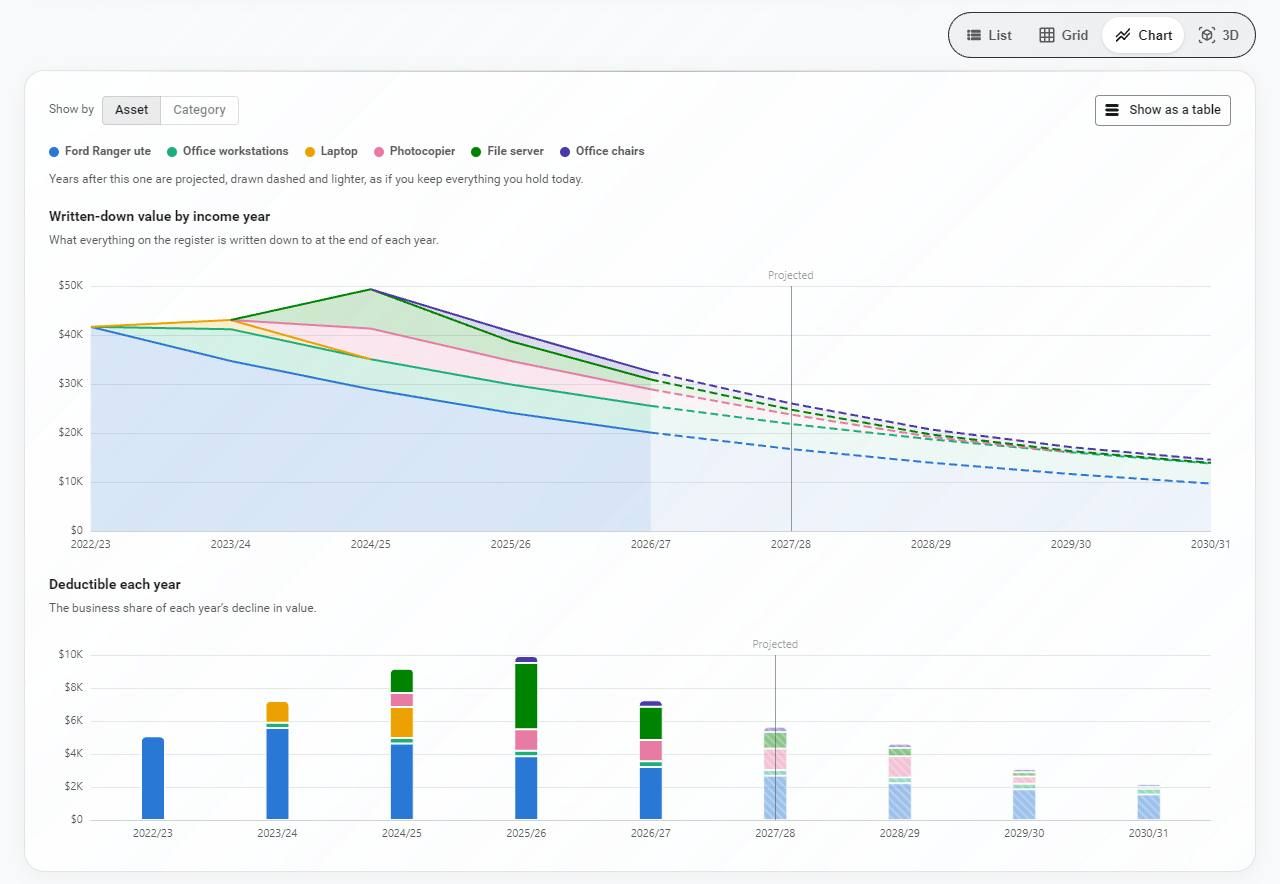
In 2Fin the schedule draws itself: what each asset is written down to at the end of every income year, the deductible amount each year, and the years ahead projected from what you hold today. See your own schedule in 2Fin.
When should you move from a spreadsheet to asset-register software?
A spreadsheet works until it does not. Watch for these signs that you have outgrown it:
- Frequent discrepancies between the register and physical counts during audits.
- A growing volume of disposals and transfers that are hard to track row by row.
- Multi-site operations where custodianship and location data get out of sync.
- Depreciation needs that span multiple methods or tax regimes at once.
Dedicated software earns its cost through automation that matters in practice: automatic depreciation schedules, journal export to your accounting software, CSV import for bulk loading, barcode or QR scanning for physical checks, attachments for service documents, and audit-ready reports on demand. Each of these reduces the risk of ghost assets, items still listed in the register but no longer physically present, because the system forces updates at the moments purchases, transfers and disposals actually happen. If your accountant works in Excel, look for software that can still send your categorised transactions to an Excel workbook or a Google Sheet.
Moving off a spreadsheet does not have to mean retyping it: 2Fin reads an existing register from Excel or CSV, checks every row before anything is saved, and builds the schedule from it. Bring your register into 2Fin.
Fixed asset register template: the columns to start with
A minimal register needs one column per identity and financial field. Here is the layout, with one example row:
| Asset ID | Description | Category | Location | Purchase date | Cost | Method | Useful life | Residual value | Accumulated depreciation | Net book value |
|---|---|---|---|---|---|---|---|---|---|---|
| VAN-001 | Delivery van | Motor vehicles | Main depot | 1 Jul 2026 | $12,000 | Straight-line | 5 years | $2,000 | $2,000 | $10,000 |
- Advanced columns worth adding: maintenance notes, warranty end date, and a QR tag reference for fast physical lookups.
- Depreciation columns: keep opening book value, annual depreciation expense, accumulated depreciation and closing book value as separate columns so a schedule can be calculated straight from the sheet.
- Naming conventions: use a consistent prefix by asset category and a sequential number, and never reuse an ID after disposal, since duplicate IDs are one of the most common causes of reconciliation errors.
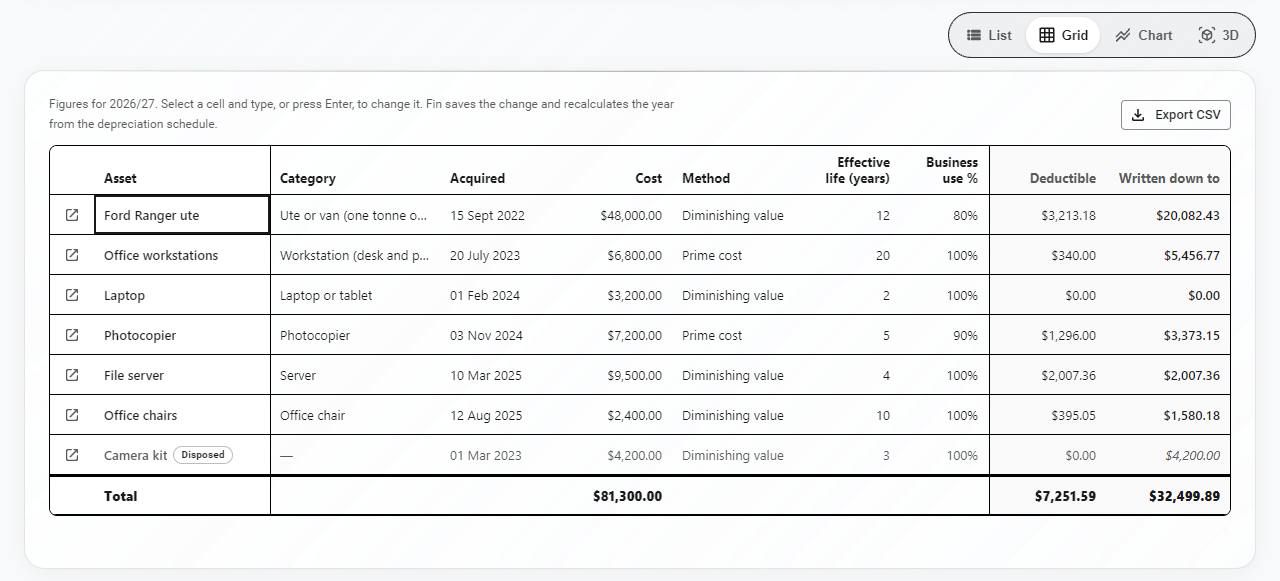
Rather keep it somewhere that fills itself in? Set up your register in 2Fin: Fin finds the purchases in your bank lines that look like assets, fills in effective lives from the category you pick, and builds the schedule for you.
How do you audit-proof a fixed asset register?
A register that lists costs and dates but nothing else will not survive a serious audit. Auditors want to verify that assets exist, are where the register says, and are maintained as claimed.
- Run an annual physical verification and reconcile every line against the register to catch ghost assets before an auditor does.
- Attach evidence to each asset record, including service reports, test tags, certificates and warranty documents, so existence and maintenance are provable rather than asserted.
- Embed updates into operational workflows so procurement, maintenance and disposal events push changes into the register automatically instead of waiting for a periodic manual sweep.
Pro Tip: Store evidence links directly on the asset record rather than in a separate folder; auditors move faster when they can click straight from the register entry to the certificate.
In the UK, section 386 of the Companies Act 2006 requires every company to keep adequate accounting records, and section 387 makes failing to do so an offence. Similar statutory duties apply elsewhere, and a well-reconciled register is the clearest evidence that the duty is being met. If you work with an accountant, it is also one of the first things they will ask for at tax time.
The short version: what to do first
The priority order that matters most is accurate inventory first, evidence links second, and automated depreciation third. Skip the physical count and nothing else in the register can be trusted. Skip the evidence links and the register becomes a list of claims rather than a verifiable record.
This order lines up with what IAS 16 and statutory record-keeping rules both expect: a record that can be reconciled and reviewed, not just one that looks complete on a screen.
Where conventional advice on asset registers gets it wrong
Most guides treat the fixed asset register as a one-time setup task: build the spreadsheet, fill in the fields, done. That framing is backwards. The spreadsheet is the easy part. The hard part, and the part that decides whether the register holds up at audit, is whether updates happen automatically when assets are bought, moved, serviced or disposed of.
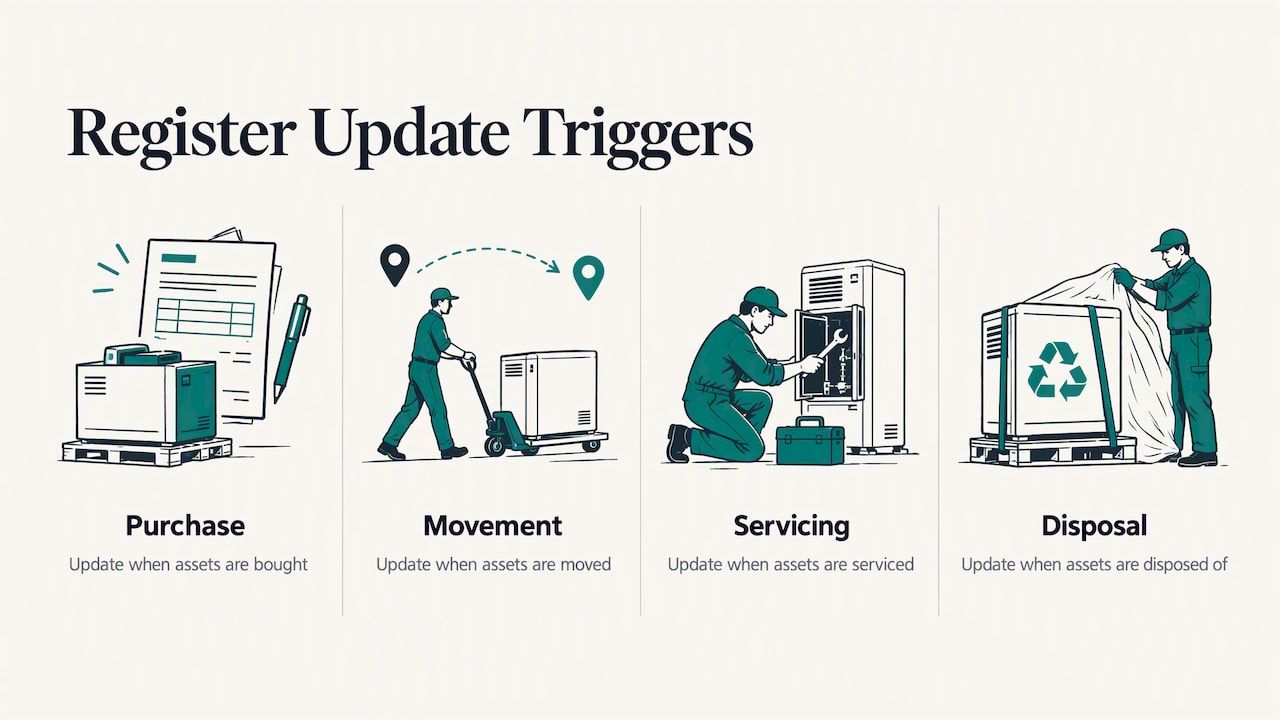
Conventional advice also overrates column count. A register with twenty fields and no physical reconciliation is weaker than one with ten fields that gets checked against reality every year. Your first move should not be perfecting a template. It should be deciding who updates the register and when, and making that update a required step in procurement and maintenance rather than a hope.
Depreciation method choice also gets more attention than it deserves relative to data hygiene. A straight-line schedule built on the wrong cost basis is less useful than a rough estimate built on accurate figures.
2Fin’s asset register and depreciation schedule
Everything in this guide, the field structure, the reconciliation discipline and the depreciation mechanics, is easier to sustain when it does not depend on someone remembering to update a spreadsheet. 2Fin’s Asset Register & Depreciation Schedule starts from the bank transaction that bought the asset, so the purchase is never retyped and the register stays connected to the rest of your books.

Fin finds the assets for you. Capital purchases in your bank lines that are not on the register yet are listed for you, ready to add in one step.
One bank line, two clocks. A capital purchase’s GST credit is settled in the quarter you buy it (through tax treatments), while the cost is written off over the asset’s effective life in the register.
A print-ready depreciation schedule. Per asset it shows opening value, cost, method and rate, days held, decline in value, private-use share, deductible amount and closing value.
Values that are rebuilt, not stored. Fix a cost, method, effective life or business-use share and every year’s figures are recalculated, so the schedule never disagrees with its own inputs.
Properties are free on every plan. Add your rental, home office or car once, tie its bills to it, and every cost splits by its rented, business and private shares. The write-off half, the depreciation of what is at the property, sits in the asset register.
Australian tax methods today. The schedule uses the ATO’s prime cost and diminishing value formulas with effective lives from the Commissioner’s determination; check with your accountant how your own jurisdiction’s rules apply.
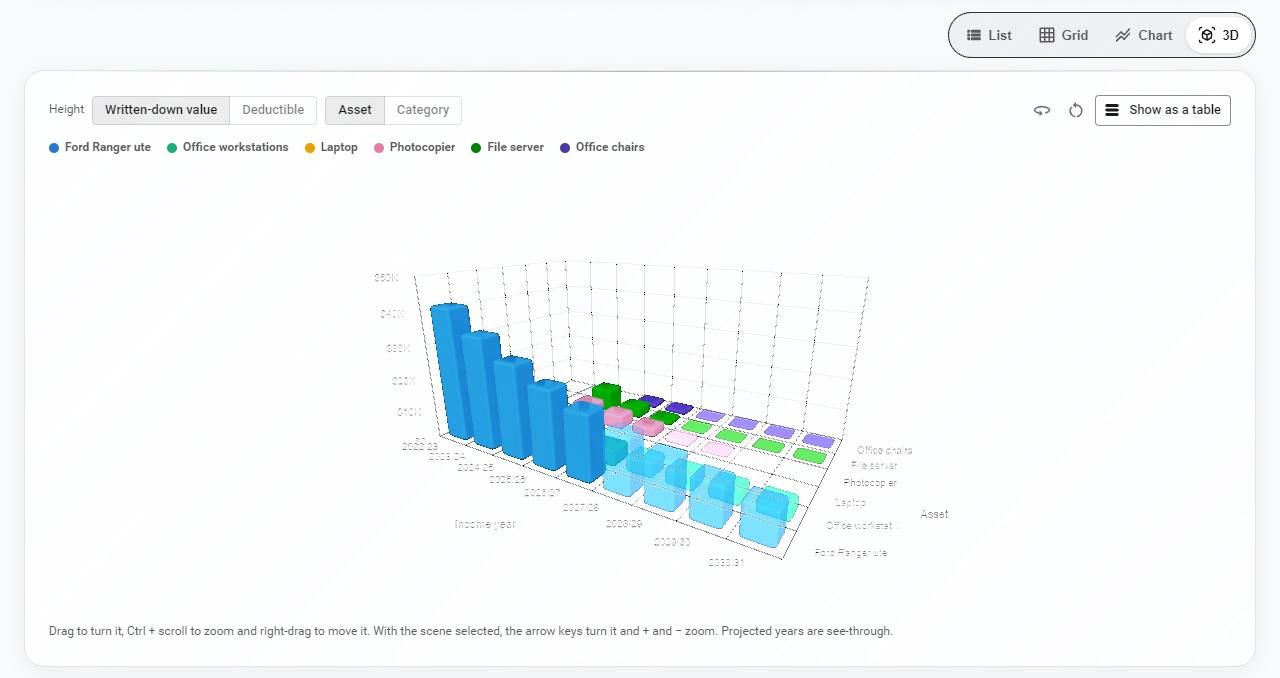
List, grid, chart and 3D. Edit the register like a spreadsheet and export it as CSV, see written-down values and deductions by year as a chart, or turn the whole register round in 3D to see which assets carry the value.
The asset register and depreciation schedule are part of the Elite+ and Auto+ plans.
See current plans and pricing, or how 2Fin works for accountants and bookkeepers and small businesses.
This article is general information, not tax or accounting advice. Accounting standards, tax rules and thresholds differ by jurisdiction and change over time, so check your own circumstances with a qualified accountant or tax professional before acting on anything here.
FAQ
What does a fixed asset register include?
A fixed asset register includes identity fields such as asset ID, description, category and location, plus financial fields such as purchase date, cost basis, depreciation method, useful life and net book value. Many registers also track service history, warranty details and disposal records to support audits and insurance claims.
What is the difference between a fixed asset register and a depreciation schedule?
The register records what you own: each asset’s identity, location, cost and status. The depreciation schedule shows how each asset’s value declines year by year, with opening value, depreciation for the year and closing value. The register feeds the schedule, so an error in the register’s cost or dates flows straight into every year of the schedule.
How do I create an asset register?
Start by defining which assets qualify, then run a physical inventory to confirm what exists and where it sits. Assign each asset a unique ID, capture its identity and financial fields, and build update triggers into your procurement and maintenance processes so the register stays current.
How often should a fixed asset register be reconciled?
At least once a year, ideally at financial year end, so the physical count and the depreciation review happen together. Update the register whenever an asset is bought, moved, serviced or disposed of, and check high-value or portable assets more often.
What is a ghost asset?
A ghost asset is an item still listed in the register that no longer physically exists or is no longer in use, for example equipment that was scrapped, lost or sold without a disposal entry. Ghost assets overstate the balance sheet and depreciation, and an annual physical verification is the standard way to catch them.
How do you track fixed assets?
Fixed assets are tracked through unique IDs, barcode or QR tags, and periodic physical verification against the register. Dedicated software can automate much of this by linking depreciation schedules, service documents and location data to each asset record.
How do I register fixed assets in Tally?
Tally, like most accounting software, has you create an asset ledger under the fixed assets group and record the purchase cost, date and depreciation details against it. The exact steps depend on your version, so check Tally’s own documentation for your release before entering data.
Why does a fixed asset register matter for audits?
A fixed asset register gives auditors a documented basis to verify that assets exist, are where the records say, and are depreciated correctly. In the UK, section 386 of the Companies Act 2006 makes keeping adequate accounting records a legal duty, and asset records are part of meeting it.
Recommended
Stay updated with 2Fin
Get the latest insights on intelligent financial management delivered to your inbox.
