Categorisation, shown working
How Fin decides what a transaction is
Every product page in this category says the same sentence about machine learning. This one shows ten real rows from the app and the decision Fin made on each — the merchant it read, the category and how sure it was, whether it is deductible, the share it assumed, and its reasoning in words. Including the rows where it was unsure.
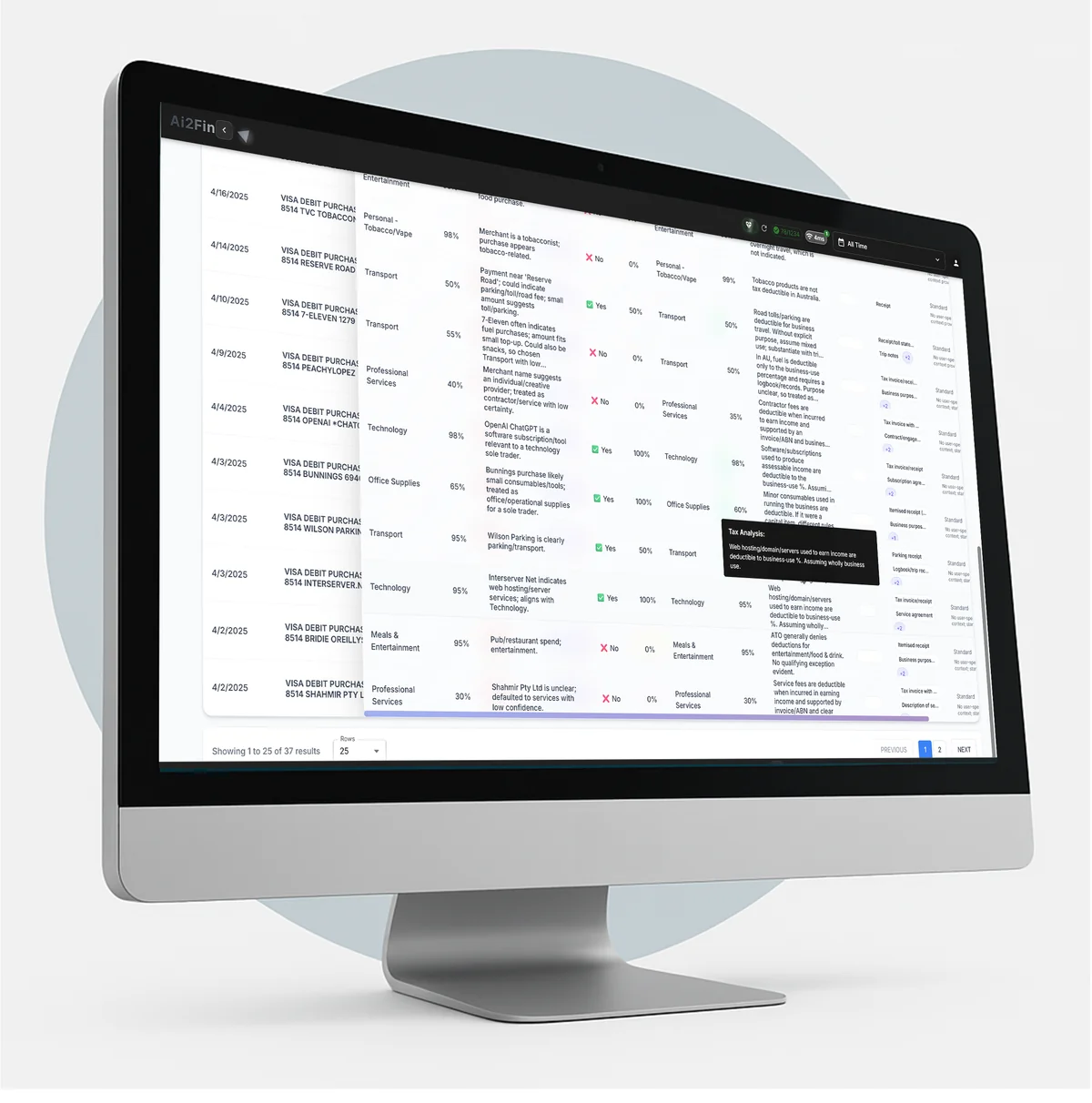
The chain, column by column
A new row arrives with nothing but the bank’s descriptor. Rules you have set are applied first, then the patterns Fin has learned from your corrections, and only then the intelligent read below — which is why most rows on an established account never reach it.
- 01
The descriptor
The string the bank sent, exactly as it arrived — a card-scheme prefix, a truncated merchant, sometimes a store number or a suburb. This is the only input Fin has for a new row.
- 02
The merchant it read
Fin resolves the descriptor to a merchant where it can, and says what it read: "Wilson Parking is clearly parking/transport", "Interserver Net indicates web hosting/server services".
- 03
A category, with a confidence
The category Fin chose and how sure it was, shown as a percentage on the row. A high figure means the descriptor was unambiguous; a low one means the same string could be several things.
- 04
Deductible or not, and the business-use share
A yes or no, and the share of the cost that is business use. Fin states its assumption where it made one — "assuming wholly business use" — so you can change it.
- 05
The tax reasoning, in words
One or two sentences on why: "Road tolls/parking are deductible for business travel. Without explicit purpose, assume mixed use; substantiate with trip…". Every row carries its own.
- 06
What to keep
The substantiation the reasoning implies — a receipt, a tax invoice, trip notes or a logbook, a contract — listed beside the row so you know what to file before you forget.
Ten rows, exactly as Fin read them
Transcribed from the screen above. The confidence is what Fin showed for that row; the reasoning is Fin’s own wording. Four of the ten are marked low confidence — those are the rows the percentage exists for.
| Descriptor | Category | Confidence | Deductible | Share | Fin’s reasoning | Read |
|---|---|---|---|---|---|---|
| VISA DEBIT PURCHASE CARD 8514 WILSON PARKIN… | Transport | 95% | Yes | 50% | Wilson Parking is clearly parking/transport. Road tolls/parking are deductible for business travel. Without explicit purpose, assume mixed use; substantiate with trip notes. | Read cleanly |
| VISA DEBIT PURCHASE CARD 8514 INTERSERVER.N… | Technology | 95% | Yes | 100% | Interserver Net indicates web hosting/server services. Web hosting/domain/servers used to earn income are deductible to business-use %. Assuming wholly business use. | Read cleanly |
| VISA DEBIT PURCHASE CARD 8514 OPENAI *CHATG… | Technology | 98% | Yes | 100% | OpenAI ChatGPT is a software subscription/tool relevant to a technology sole trader. Software/subscriptions used to produce assessable income are deductible to the business-use %. | Read cleanly |
| VISA DEBIT PURCHASE CARD 8514 BUNNINGS 6940 | Office Supplies | 65% | Yes | 100% | Bunnings purchase likely small consumables/tools; treated as office/operational supplies for a sole trader. If it were a capital item, different rules apply. | Right category, check the assumption |
| VISA DEBIT PURCHASE CARD 8514 7-ELEVEN 1279 | Transport | 55% | No | 0% | 7-Eleven often indicates fuel purchases; amount fits small top-up. Could also be snacks, so chosen Transport with low confidence. In AU, fuel is deductible only to the business-use percentage and requires a logbook/records. Purpose unclear, so treated as private. | Low confidence — add context |
| VISA DEBIT PURCHASE CARD 8514 RESERVE ROAD… | Transport | 50% | Yes | 50% | Payment near 'Reserve Road'; could indicate parking/toll/road fee; small amount suggests toll/parking. Without explicit purpose, assume mixed use. | Low confidence — add context |
| VISA DEBIT PURCHASE CARD 8514 TVC TOBACCO… | Personal — Tobacco/Vape | 98% | No | 0% | Merchant is a tobacconist; purchase appears tobacco-related. Tobacco products are not tax deductible in Australia.Fin read this as a personal purchase, which is what the descriptor and amount suggested. A tobacconist buying stock for resale is a different transaction — trading stock, not a personal expense — and would need that context added. | Read cleanly |
| VISA DEBIT PURCHASE CARD 8514 BRIDIE OREILLYS | Meals & Entertainment | 95% | No | 0% | Pub/restaurant spend; entertainment. ATO generally denies deductions for entertainment/food & drink. No qualifying exception evident. | Read cleanly |
| VISA DEBIT PURCHASE CARD 8514 PEACHYLOPEZ | Professional Services | 40% | No | 0% | Merchant name suggests an individual/creative provider; treated as contractor/service with low certainty. Contractor fees are deductible when incurred to earn income and supported by an invoice/ABN and business purpose. | Low confidence — add context |
| VISA DEBIT PURCHASE CARD 8514 SHAHMIR PTY L… | Professional Services | 30% | No | 0% | Shahmir Pty Ltd is unclear; defaulted to services with low confidence. Service fees are deductible when incurred in earning income and supported by invoice/ABN and clear description. | Low confidence — add context |
What the low-confidence rows are for
The 7-Eleven line is the honest case. From the descriptor alone it could be fuel or a snack; fuel is deductible only to a business-use share that a logbook supports; so Fin marked it private at 55% and said why, rather than inventing a share. Reserve Road, Peachylopez and Shahmir Pty Ltd are the same shape: a plausible read, a stated assumption, and a number low enough to make you look.
One correction settles each of them, and the correction becomes a learned pattern — the next 7-Eleven line on your feed arrives already knowing whether it is fuel at your logbook percentage. The percentage is a prompt, not a score card: no accuracy benchmark has been published, and this page does not claim one.
What to keep, row by row
Beside each row the app lists what would back the decision up — a receipt or toll statement and trip notes for parking, a tax invoice and the subscription agreement for hosting, an itemised receipt and the business purpose for the hardware run. That is the substantiation the reasoning implies, named while the purchase is still fresh.
Where the row is a GST purchase, the tax treatment column carries the code beside it, and a tax invoice is what turns the reasoning into a credit on the activity statement. Car rows point at the logbook method.
How the decision works
Questions about how Fin decides
- Why does Fin show a percentage next to the category it chose?
- It is how sure Fin was about that one row, from the descriptor alone. A tobacconist or a named parking operator reads cleanly and scores high; a 7-Eleven line could be fuel or snacks from the same string, so it scores low. The figure is a prompt to look, not a measure of overall accuracy — no benchmark has been published yet.
- What does Fin do first when a new transaction arrives — rules or the model?
- Rules you have set come first, then the patterns Fin has learned from your earlier corrections, and only then the intelligent categorisation you see reasoning from on this page. Most rows on an established account resolve at the first two steps without any request at all.
- What changes when I correct a category or a business-use share?
- That row is fixed straight away, and the correction becomes a learned pattern for the next row that looks like it. Correcting the Bunnings line to a capital purchase, or the 7-Eleven line to fuel at your logbook percentage, is how Fin learns what those descriptors mean for you.
- Does Fin decide on its own whether something is deductible?
- It proposes: a yes or no, a business-use share, and the reasoning behind both, with the assumption named where it made one. You decide. The reasoning is there so you can see why before you accept it, and the "what to keep" note says which receipt, invoice or trip record would back it up.
- Why did a fuel station come up as private with low confidence?
- Because the descriptor alone cannot say whether the purchase was fuel or snacks, and fuel is only deductible to a business-use share that a logbook supports. Rather than guess a share, Fin marked it private at low confidence and said so, which is the signal to add the context once — after that it knows.
- Can I see the reasoning for every transaction, or only the uncertain ones?
- Every row carries its reasoning in words, the way the ten on this page do, alongside the category, confidence, deductible flag and business-use share. The low-confidence rows are simply where that reasoning most repays a glance.
See it read your own rows
Import a statement and every line arrives with its category, its confidence and its reasoning, the way the ten above did. Free to start, no card needed.
Get 2Fin free