What Does Overhead Mean in Business? a Clear Guide
What does overhead mean in business? See fixed, variable and mixed costs, and how they change your price and the cash you must keep.

Overhead means indirect costs required to run the business that cannot be traced to one product, service or job, such as rent, insurance and admin pay.
Your studio light is still on, you're checking the next invoice, and the bank balance looks smaller than the amount of work you've finished suggests. The missing piece may be the cost of keeping yourself ready to work, not just the cost of completing the work you've sold.
What Overhead Means When the Lights Stay On
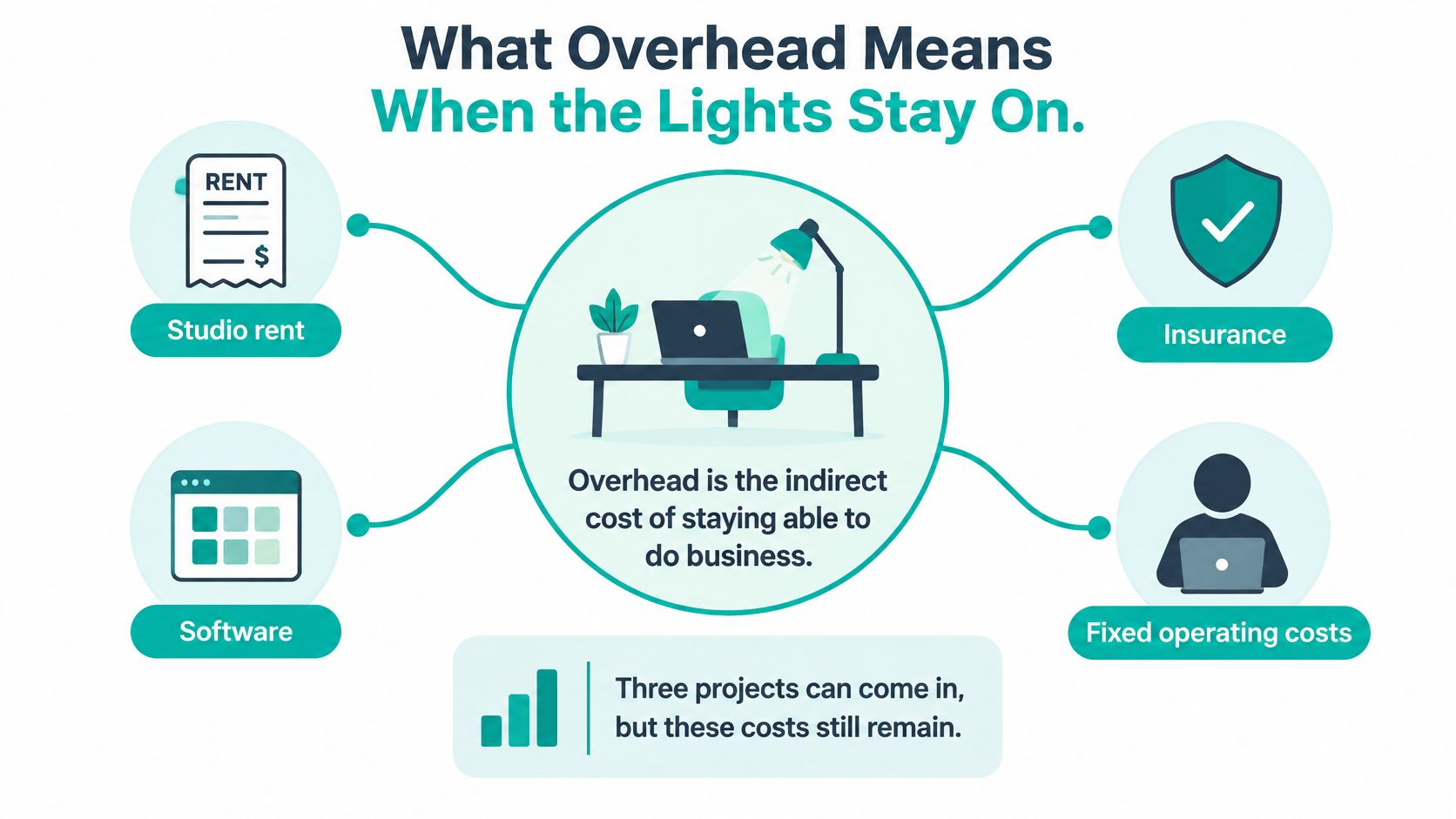
Say you're a freelance designer who books three projects. You'll pay for the same studio, shared design software and business insurance whether those projects arrive together or leave gaps in your calendar.
A subcontractor hired specifically to animate one client's logo is different. You can assign that invoice directly to the client's project without deciding how to share it with anyone else.
That's the useful starting point for understanding what overhead means in business: follow the dollar to the work, rather than guessing from the supplier's name.
The stage stays lit between performances
Think of overhead as the cost of keeping a stage available between performances. Selling another ticket doesn't necessarily change the rent, and cancelling a performance doesn't necessarily release you from paying it.
The same idea applies to a workshop, recording room or home-based practice. You need somewhere to operate, systems to organise work and protection against business risks. Those shared resources support your ability to earn, even when they aren't exclusively used by a particular customer.
The distinction is easier to see when you separate the shared workspace from the work delivered inside it.
Why the distinction changes decisions
For the designer, the practical questions are different:
- Can I afford a quiet spell? Shared commitments may continue while client payments slow down.
- Did I price the project properly? Covering the animator's invoice isn't enough if nothing remains to support the studio.
- Which work is worthwhile? A project that looks profitable before shared expenses may look less attractive once you include its reasonable share.
Don't confuse overhead with waste. Bookkeeping, suitable insurance and dependable software can be useful business resources. The question is whether you're using them sensibly and earning enough to pay for them.
Nor does calling a payment overhead settle its tax treatment. Your internal costing decisions and your tax records answer different questions.
Practical rule: If you can't point a business dollar at a particular job without using a sharing rule, treat it as overhead for management reporting.
That test gives you a workable classification. You still need to understand how the cost changes when the amount of work changes.
Fixed, Semi-Variable and Variable Overhead
How overhead behaves and what it does to a price
| Cost behavior | What stays stable | Everyday examples | Effect on a quote |
|---|---|---|---|
| Fixed overhead | Does not change with volume in the period | Rent, salaried admin, property tax, insurance, interest, depreciation | Sets the cash floor you must cover before profit |
| Semi-variable overhead | A base charge, then a rise past a usage level | Telephone, repairs, indirect labor, fuel, power | Needs an activity assumption or the base is missed |
| Variable overhead | Rises with output but is not traced to one unit | Shop supplies, indirect materials used across jobs | Add a per-job or per-hour amount |
| Direct cost, not overhead | Traced to one product, client or job | Job materials, a subcontractor on that client, hours on that project | Price inside the job; do not spread it across others |
The U.S. Small Business Administration's planning guidance identifies rent, salaries, property taxes, insurance, interest and depreciation as fixed-cost examples, and distinguishes semi-variable expenses that combine stable and activity-related elements. Its illustrative designer's rent stays $1,500 per month regardless of the number of projects, while electricity may increase when more equipment runs.
Fixed doesn't mean permanent
A fixed expense stays stable within the period and operating conditions you're considering. Your landlord might change the rent when the lease renews, or you might eventually need a larger workshop. Neither possibility makes today's rent an activity-based expense.
The useful budgeting question is whether accepting more work changes the bill during the period you're planning. If it doesn't, don't increase the total rent estimate just because you expect a busier month.
Also distinguish an expense from a cash payment. Depreciation belongs in a cost calculation, but it isn't a fresh bank withdrawal each month. A cash budget needs payment dates, not just expense categories.
Mixed bills need a workload assumption
A phone plan with a standing charge and additional usage is a straightforward semi-variable example. Budgeting only the standing charge understates a busy period; treating the entire previous bill as unavoidable may overstate a quiet one.
A workshop's electricity can behave similarly. Keeping basic services available is different from running equipment throughout the working day.
For mixed bills, record:
- The standing component. Identify what you'll pay even with minimal activity.
- The activity driver. Note whether calls, machine use, travel or another measurable activity increases spending.
- The expected workload. Use the work you realistically expect, not maximum capacity.
Variable overhead needs another distinction. Cleaning materials or small supplies consumed across a workshop can increase with output without being worth tracing to every individual job. Timber bought specifically for a particular build belongs directly to that build instead.
The expense label alone won't decide which treatment fits. Fuel used for a documented project journey may be traceable; fuel consumed across general business travel may require allocation.
Before calculating a rate, mark each recurring bill fixed overhead, semi-variable overhead, variable overhead or direct cost. Otherwise, you'll build a precise-looking formula around costs that don't behave the way you've assumed.
How a Shared Cost Becomes a Job Price
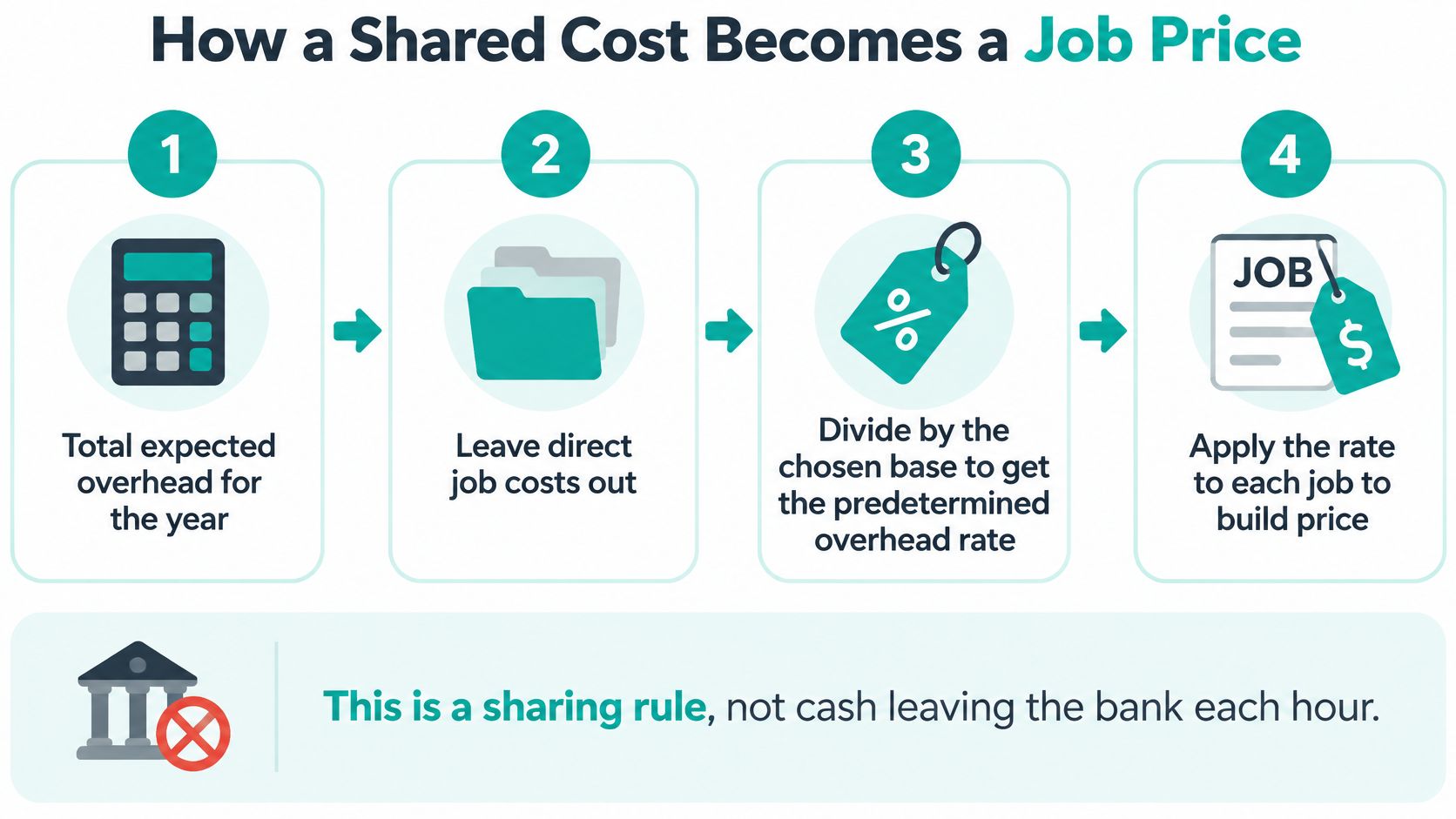
A predetermined overhead rate turns an estimated shared cost into an amount you can assign to work. It's a costing rule, not a record of cash leaving your bank account whenever someone starts a machine.
The aim is to give each job a reasonable share of the resources it uses. Getting the arithmetic right matters, but choosing a sensible basis for sharing matters just as much.
Build the rate in a practical order
- Total expected overhead for the year. Include the shared business costs you intend to recover through sales. Leave direct job materials, project subcontractors and other directly assigned costs out of this pool.
- Choose an allocation base. Use a measure that reasonably explains resource use, such as machine hours, direct-labor hours, billable hours or comparable jobs. Revenue can be a practical alternative when hours are a poor proxy, but it shouldn't conceal large differences between jobs.
- Divide overhead by the estimated base. Keep the periods consistent. An annual overhead estimate needs an annual activity estimate.
- Apply the rate to the job. Multiply by the activity expected for that piece of work, then add its direct costs before deciding what profit the price should leave.
The workflow separates collecting expenses from assigning them.
A factory example in dollars and hours
The Corporate Finance Institute's job-order costing example divides $450,000 of estimated annual manufacturing overhead by 75,000 machine hours, producing $6 per machine hour; a production run using 5,000 machine hours therefore receives $30,000 of applied overhead.
The factory didn't necessarily spend that hourly amount as each hour passed. It used the rate to assign shared rent, maintenance, indirect labor and utilities to production.
An automated shop may find machine hours representative because equipment use explains much of its shared workload. A labor-heavy operation may find labor hours more useful. Neither base is automatically correct just because it's easy to export from a spreadsheet.
For a service business, substitute realistic billable hours for machine hours. Don't use every hour you're available: quoting, administration, business development and unpaid gaps can leave fewer hours available to sell.
A rate based on hours you can't realistically bill can make a price look sufficient on paper while leaving shared costs unrecovered.
If fewer hours are sold than expected, the original rate won't automatically recover the full overhead pool. You may need to revise your forecast, improve utilisation, adjust future pricing or reduce commitments. Raising every current quote sharply isn't the only response, especially if the quiet period is temporary.
Use an estimate for pricing and compare it with actual results later. A rate is useful because it supports decisions, not because it makes uncertain future activity exact.
Take a recent invoice and reconstruct its cost: direct materials, direct labor or subcontractors, plus applied overhead. Compare that total with the price charged and ask whether the remaining margin is one you'd knowingly accept.
When One Rate Misprices the Busy Job
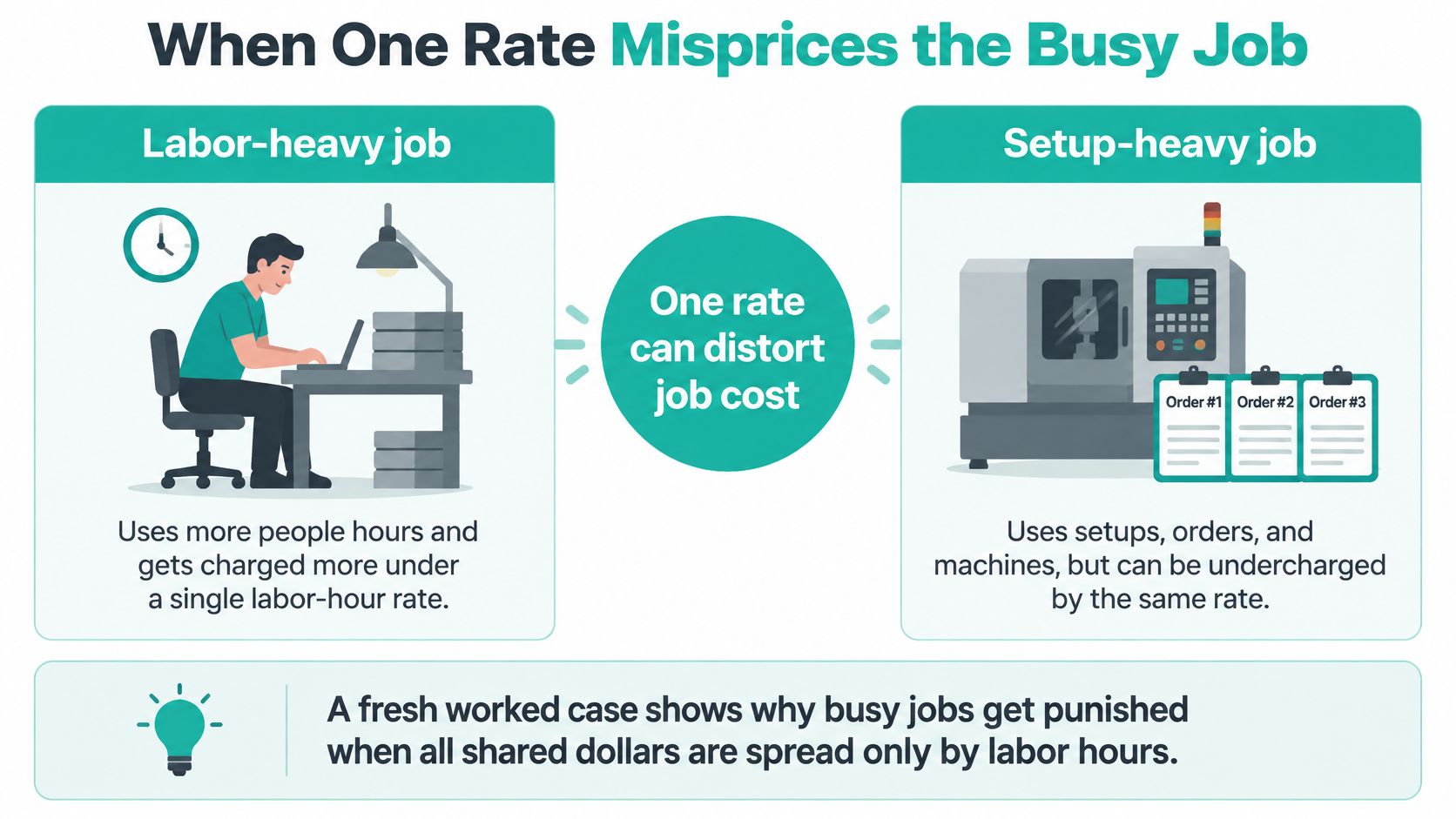
A standard product can receive a larger overhead charge than a luxury product even when the luxury product demands more setups and ordering work. That happens when the business measures only labor time and overlooks other shared activities.
In the Corporate Finance Institute's activity-based costing example, a standard product using five labor hours receives $80 of overhead, while a luxury product using four hours receives $64, under a broad rate calculated from $800,000 of annual overhead and 50,000 labor hours.
The comparison shows why the choice of driver can change reported job profitability.
Different activities need different measures
One labor-hour rate versus activity rates
The same worked example provides these rates. The activity rows shown are selected portions of the overall pool, not a complete reconciliation of every overhead expense.
| Method | Pool | Base | Rate | What a job is charged |
|---|---|---|---|---|
| Single labor-hour rate | $800,000 overhead | 50,000 labor hours | $16 per labor hour | $80 for a five-hour standard product, $64 for a four-hour luxury product |
| Labor-related activity | $80,000 | 50,000 labor hours | $1.60 per labor hour | Only the labor-related slice of overhead |
| Machine setups | $150,000 | 5,000 setups | $30 per setup | Each setup, regardless of labor hours |
| Production orders | $70,000 | 400 orders | $175 per order | Each order processed |
| Factory machine time | $250,000 | 40,000 machine hours | $6.25 per machine hour | Machine time actually used |
Activity-based costing separates expenses into pools associated with particular activities. Instead of making labor hours explain everything, you assign setup costs through setups and ordering costs through orders.
Don't add the broad rate to all the activity rates. They're alternative approaches to allocating overhead, not cumulative surcharges. You also can't calculate a complete activity-based product cost without knowing how much of each activity the product consumes and accounting for the remaining pools.
Apply the idea without building a factory model
Say a studio handles a straightforward logo adjustment and a campaign requiring repeated approvals, file preparation and equipment bookings. Production hours alone may not capture the difference in shared support.
A trade business can face the same problem when a short installation needs repeated site visits. The installation time may be modest while travel coordination and preparation take substantial effort.
This video offers another way to follow the costing concept.
You don't need elaborate tracking for every small expense. Start with a shared activity that materially separates demanding jobs from straightforward ones.
Choose something you can consistently count, such as setups, orders, site visits or machine time. Keep a single rate when jobs consume shared resources in broadly similar ways; split the pool when that simplification repeatedly produces misleading costs.
Bills That Are Only Partly Overhead
A rent-and-utilities list won't tell you how to classify every business payment. Overhead isn't every business expense, and the name printed on a receipt doesn't settle whether a cost is direct, shared or personal.
The U.S. government's SBIR accounting guidance defines indirect costs as costs that can't be associated with a particular project and notes that smaller businesses often group general and administrative costs together as indirect costs.
Test usage before choosing a category
Use this sequence rather than assigning the whole bill by habit:
- Traceable to a job. If a particular client or project caused the expense and you can economically identify it, assign it directly.
- Shared across the business. Put the business cost in an indirect pool when it supports multiple jobs and requires a sharing rule.
- Personal or mixed-use. Exclude personal spending from business costs. For a shared bill, document the business portion rather than assigning the entire amount to work.
A design subscription used across your client work usually supports the practice as a whole. A specialist add-on bought exclusively for a particular commission may be a direct project cost.
A tradie's vehicle may serve client visits, general business errands, and the school run. Keep a journey log that distinguishes those purposes; don't classify every vehicle payment as overhead just because the van carries tools.
A creator's camera can support client filming and personal projects. Record business use and retain the purchase documentation, while recognising that buying an asset isn't necessarily the same as incurring a routine operating expense.
Home internet needs a supportable allocation too. Write down how you've estimated business use and revisit the method when household or work patterns change.
Keep management, pricing and tax views separate
For management reporting, you're asking which work consumes resources and how the business performs. For pricing, you're deciding how to recover business costs through paid work. A fixed annual subscription can therefore produce a per-client allocation without its total subscription price changing.
For tax, different rules apply. The IRS guidance on business expenses says deductible operating expenses generally must be ordinary, meaning common and accepted in the trade, and necessary, meaning helpful and appropriate; it also explains that prepaid costs may not be immediately deductible and certain costs must be capitalized.
That's U.S. guidance, not a universal tax rule. An annual insurance premium can require different timing from a monthly subscription, and equipment purchases may need different treatment from routine repairs.
Keep the evidence with the decision: Record the date, business purpose, receipt and allocation method, then review the split when actual use changes.
The cash payment has its own timing regardless of the classification. A cash flow forecast for a small business helps you place those payments when they're due rather than confusing a costing allocation with a bank movement.
Build Your Cash Floor and Price From It
A studio light stays on even between shoots. For a business, rent, insurance and software can keep costing money when no jobs are underway. Add up the payments you must make to keep operating, and you have a useful monthly cash floor.
Include committed rent or the business share of housing, insurance, admin pay, software subscriptions and loan interest. Add scheduled equipment payments and the standing parts of mixed bills, such as phone access and basic power. Include fuel or repairs only if they would remain unavoidable in the scenario you are planning for. A busy month's spending is not automatically a minimum commitment.
Separate the payment floor from the full budget
Depreciation belongs in your cost calculations, but it is not another bank payment on top of an equipment instalment. Loan principal works the other way: it can require cash even though it is not an operating expense in your profit calculation.
For annual bills, record both a monthly funding allowance and the actual due date. Setting money aside helps you prepare; a cash forecast still needs to show when the supplier will collect payment.
In a 2025 KeyBank survey, 46% of small-business owners surveyed said they were certain they could cover one month of operating expenses if an emergency arose. Treat that as context, not as your target. Your floor should come from your own commitments. Compare it with available cash, excluding money already reserved for tax or other obligations.
Monthly cash floor = committed business payments + unavoidable standing charges
The floor is not a full survival budget. Active jobs may still require materials and subcontractors, and you may need personal drawings for living costs. Keep those needs visible beside the overhead floor.
Use statements and invoices to support each amount.

Turn bank lines into a pricing check
- List costs from the last quarter, using 90 days of bank activity as a working window. Gather statements, card transactions and receipts. Check separately for annual bills that do not appear in that period.
- Mark each payment as traceable to a job, shared overhead, or personal and mixed. Keep the business-use calculation beside mixed transactions.
- Calculate the shared monthly floor. Include standing portions of phone, power and relevant transport commitments. Keep irregular payment dates visible in your cash forecast.
- Choose a countable allocation driver, such as billable hours, jobs or site visits, and apply it to a recent job.
- Compare the job's full cost with its price. Record the gap and whether it came from the quote, actual resource use or an unrealistic workload assumption.
Compare the cash floor with available money and realistically timed receipts, not invoices you hope to send. A cash flow forecast can show why timing matters: a job may look profitable on paper but bring in cash after the next payment is due.
Make the review repeatable
AI2Fin's automatic type detection identifies business expenses, personal spending, tax-deductible costs and recurring payments without manual tagging. Spending can be grouped by project, client or cost centre and compared with cost of goods sold against sales. Fin also sorts expenses, surfaces deductions and keeps books tidy, so tax time becomes a review rather than a reconstruction.
Before sending a quote, check that it covers direct work, a reasonable overhead allocation and the profit you intend to retain. If it falls short, change the scope, price or delivery method deliberately.
AI2Fin helps organise business spending and view costs by project or client, making shared expenses easier to review alongside sales. Visit AI2Fin to organise transactions and make your next pricing decision with a clearer view of overhead.